Corrected Assumptions
Re-written to focus again on the fact that Newton’s ‘law’ of gravitation is fundamentally wrong. This was stated on the Home Page and made it the bounden duty for every academic on the list below to respond comprehensively and utterly honestly to what was published on that Page.
All leading expert geophysicists and geochemists have long been in a state of irrational denial that Natural Laws(NL) and Laws of Physics(LofP) do not always apply, that landscape dynamics did not lift mountain ranges outwards into the much less dense atmosphere, nor fossils into the same atmosphere, nor mid-ocean ridges into the oceans, and nor that mantle penetrating impacts delivered Earth’s wealth of water in a comet and three asteroids.
In short, making assumptions is not the way to do science when facts tell the incontestable truth.
And nor did academics ever look for alternative explanations for Newton’s or their own assumptions either on Earth or elsewhere in the universe.
The outcome of all this is that it is our inescapable duty to require all the following academics to try in letters to defend their assumptions against the facts.
It bears repeating and stressing that
it is what matter does that defines forces, not the forces that define what matter does.
Sir Duncan Wingham, Dr Colin Summerhayes, Prof Dan McKenzie, Prof James Jackson, Prof John Ludden, and Prof Dietmar Mueller.
IT WILL BE OF UNPRECEDENTED IMPORTANCE FOR EACH OF THESE PEOPLE TO RESPOND INDIVDUALLY BOTH COMPREHENSIVELY AND SCIENTIFICALLY TO THE HOME AND FOLLOWING NOTES.
IGNORING THIS REQUIREMENT WOULD BE IMPOSSIBLE TO JUSTIFY.
The Notes were drafted on the basis of what was considered wrongly to be true in Plate Tectonic Theory (PTT) at various times in the past. Any errors by me Chris Eaton, made due to the importance of the present situation, would be corrected easily.
The Notes are for sale and should obviously be bought by all earth scientists at a high price because they no less than change science.
Note 1. On PTT’s manifestly impossible Mechanism, its overlooked NL and LofP Alternative, and selected Ramifications of greatest Significance.
1.1. Introduction. Fundamentally wrong academic geological basic beliefs were found easily by testing,
- which basic theories’ premises were assumptive and which were facts, and
- whether the assumptions complied with the scientific method’s demands for necessity, realism, coherency of interpretations based on them, and capacities to withstand sceptical testing.
This Note proves that maybe the most basic assumption in Geology, Newton’s Law of Gravitation, was irrational, with unprecedentedly serious consequences impacting on all Earth Science and beyond. So please keep this fact in mind and that there is no escaping the disproof.
Academia lives by two codes of practice. One is for individual academics and their institutions to gain recognition of excellence by publication via peer review. The other is to foster and engage in dialogue with the public, of which industrial scientists and engineers are equally skilled members. I respectfully call on the academics to honour the second code.
1.2 Why the assumed mechanism was impossible. In its most widely held form PTT assumed what no matter could conceivably do to create heat engines imagined to be driving a circulatory mechanism in the mantle.
Radioactive mineral grains, and only them, were assumed to cluster themselves to form the engines. Magma between and around the grains was then assumed to be heated by the minerals’ decay so as to trigger and drive the so-called Rayleigh Taylor Instability (RTI), a form of instability that has defied all attempts to replicate it in practical tests. By definition the clustering would obviously have broken NL and LofP well before RTI’s triggering temperature could conceivably have been reached.
But more was indefensible. All the radioactive mineral grains were assumed to defy up to hundreds of millions of years of viscous magma’s attempts to move them as it flowed through or around the clusters to be heated.
Furthermore, supposedly critically heated magma was assumed to embark en masse on monstrous mutually interfering circulations, all with no gradual growth or need for any heat boosts.
All these assumptions defied Laws born of universal observation with no reason for doing so – that is for instance the Law compelling all relatively dense matter to sink as steeply as possible towards Earth’s centre. Any of lower relative density rises. Both compulsions clearly represent matter seeking stable density levels.
PTT therefore assumed two impossible mechanisms for no valid reason, the first being one preparing for the second.
And still more, it is demonstrable that not one stage in academic PTT’s entire imagined dynamic process has ever passed any representative practical or even thorough desk-top test. So may I ask every reader to think for the short time needed to realise that a bit of simple logic absolutely demolished, once and for all, a fundamental theory held to be as good as scientific law for four centuries and one that has guided governments worldwide that long when formulating environmental policies.
Following Notes show that several more basic assumptions were just as incontestably wrong.
1.3. Overlooked Alternatives. One is the universal dynamic Law summarised above. Another is the Law that spontaneous/automatic downhill flow en masse of any overall liquid solid/liquid mixture requires pre-existence of a downslope under penetrable relatively low-density material. This is so obvious a fact that it defies reason why it passed unnoticed.
It must mean, as in the world we inhabit, that any liquid mixture always subducts automatically down into less dense material. Just look at any river subducting through and under air.
How inexplicable it was therefore for the entire earth science community to become fixed in irrational assumption that liquid magmatic mixtures were being at least partly pushed from behind, and only in opposite directions across oceans on long straight but often sharply offset fronts after rising en masse out of localised heat engines within the mantle.
These were assumed when everybody knew that any stew heated on a hob changed composition such that densified relatively heavy fractions sank, and lightened, more mobilised fluids percolated upwards, with no net directional movement.
Nothing else ever happened in the real world in any comparable scenario, and nothing else needed to be happening to explain everything about the Earth’s crust after recognising all the ample evidence for mantle-penetrating impacts.
Another way of expressing both Laws is that all matter in the Earth is constantly tending to improve the planet’s roundness such that it is also being layered concentrically at all levels according to density. And facts prove that this involves expansion of the Earth in a process of decompaction and re-stabilisation after impacts.
All ways of expressing the Laws are far more meaningful than by using Mathematics. This is due to them clearly not only operating in accordance with tidy formulae. They also exploit every single random accident tending to move material down or up even very slight slopes, as appropriate. Only impacts, life forms and maybe forces of crystallisation can do the opposite.
There is manifestly a basic dynamic density sorting compulsion, and readers are assured again that this fact answers all questions posed by the Earth’s crust in a perfectly coherent way. It therefore must be accepted that Earth’s independent flows were non-circulatory and always instigated by events ahead of flows, not behind them by impossible engines diametrically opposite where down flows began.
1.4. Selected Ramifications. In light of the above nothing relying on PTT’s dynamic principles can be entirely right, including all sub-surface interpretations in Physical Geology.
And, most urgent, we trust the earth science community will recognise our duty to assert that all this is far from academic by it connecting wrong beliefs directly to,
- new major considerations about the safety of people living and exploring for oil in highly dangerous regions of the world,
- ill-conceived constraints on the general public’s freedom of action, and many companies’ ethical profitability and share values,
- corresponding wrong education,
- rights being demonstrably denied to the general public or industrialists by there being no official way to obtain answers to key questions in the public domain from Government’s scientific advisors, and
- a huge lost public relations advantage by any influential party in society urging research into ways promising to predict potentially deadly earthquakes and volcanic eruptions far more accurately than PTT can.
In short these Notes inescapably leave earth science advice to governments in dire need of root and branch review. As just one more example, the Laws reveal that purely geological factors could well be changing both absolute and relative sea and land levels so as to cause various threats to life and environmental changes on the decades to century timescale. They are all largely independent of carbon emissions by humans.
In fact they explain many more of our planet’s extraordinary geological features in ways not fitting into PTT.
And, to sum up, all this means that the Earth’s crust is categorically not, first and foremost, a mosaic of plates formed at tectonic speeds. The plates exist only because certain ones were pre-formed at far greater impact speeds.
In these circumstances the earth science community will surely have to admit that it has inadvertently long guided humanity incorrectly, perhaps most tragically on safety and general well-being matters.
Note 2. A new Perspective on how NL and LofP are broken in Geology.
2.1. Introduction. Geology is admirably factual when informing the world about what the Earth’s sedimentary rocks are, where they occur now, and when they were originally formed.
But when geological academia tries to explain why and how igneous and metamorphic rocks, their structures and the oceans were formed and came to be where they are, it is largely assumptive. For instance, although established leaders might claim otherwise, such beliefs as about the volumetric development of the hydrosphere, and when mantle-penetrating impacts last occurred were undeniably conjectural.
Normally, PTT is viewed by academia as an example of physical laws applying at the surface being overwhelmed in the Earth rather than as common-sense explanations for actualities being subordinate to beliefs in impracticalities.
This Note lists only a fraction of the ways in which the second perspective is in fact that much more than PTT is so wrong that students, governments, companies, the global public and indeed other scientists have been disastrously misled.
2. Discussion. The earth science community is hereby being asked respectfully to acknowledge publicly that it cannot objectively substantiate denial of any of the following.
- Flaws that have not been sought as they should have been in basic geological hypotheses. PTT, the age of the hydrosphere as we know it, and when mantle-penetrating impacts stopped are only some of the cases in point.
- NL and LofP born of universal observation were needlessly and impracticably assumed to be overwhelmed in several mechanisms operating below rockhead. Note 1 proved this for magma with shocking finality. There was also never any need or justifiability for two-way ridge spreading, thermal subsidence, or recycling of sea water through ocean crust. See later Notes for these hypotheses being disproved by factual geology’s(FG’s) adherence to NL and LofP, and thereby avoidance of assumption. Other Notes will show further why FG must now be held paramount over its standing free thinking (= assumptive) alternative in explaining everything about all rock, water, and makings of it and other volatiles below rockhead.
- This set of Notes proves why it was inevitable that none of Geology’s assumed mechanisms conflicting with NL/LofP could be replicated in tests and that no attempt to explain ocean floor features based on any of the mechanisms could stand the test of time. In hindsight, neither weakness should have been accepted but geological academia was not held publicly accountable. Nor was a publishing system called to account for not asking why so many changes were necessary. The Conclusions below cite two highly relevant facts regarding peer review and the written record.
- While industrial scientists’ work is rightly routinely inspected and, if necessary, challenged by scientific authorities, it has been illogical and extremely costly to academia, industry and the Public alike for the reverse not to have been implemented in law. These Notes will prove this incontestably. So, there was never any justification in presuming academia’s authoritativeness.
- Earth Science research has become so specialised and free-thinking that its leaders should have arranged for cross-disciplinary scrutiny to ensure that impractical or conflicting principles did not develop. After reading these Notes you will need no further proof of this.
- Geological facts have been forced unconvincingly into theories instead of changing the latter to accommodate the facts. For an example see a Note below discussing black smokers.
- Natural phenomena’s causes and effects have demonstrably been confused at clear cost to realism or betterment by reversal. For example a Note below discusses reasons for different angles of subduction. Briefly and more generally there is no way it was better to infer that all movements of ocean crust were caused by something happening upstream when Laws shows that the opposite is the invariable fact. That is, at the surface the cause of all movements of rock invariably lies downstream so that they are, as expressed in Soil Mechanics, viewed best as effects aptly termed drawdown.
- Actualities have too often been claimed in Geology to be not what they looked like when acceptance of appearances would have answered basic problems posed by the Earth. For instance, standing claims that what could only realistically/reproducibly be meandering and structurally controlled sub-aerial river courses and canyons were produced in deep water by turbidity currents. See another Note for further discussion of this.
- Sampling has been insufficient in academic geological method for analytical results to be reliable. Industrial experience has proved it such that this should be a topic for debate to avoid more errors or inadequacies in future submissions for publication.
- In key instances kinematics and other seemingly valid Mathematics in PTT have been as unrealistic as grammatically correct language can be. For example the most crucial test for this lack of realism was missed by carelessly giving the mathematical RTI function only one density variable when nearly all magmas are generally accepted to be multi-density mixtures.
- No inquests are undertaken into why there is so much variation of ideas in PTT, or if they might reveal that something is fundamentally wrong in the Theory’s principles.
2.3. Conclusions. All the above and more failings have had major consequences. Three were putting lives at risk by default and causing earth science education and advice to governments to be incontestably fundamentally wrong. They are also currently very questionably restricting the Public’s and industries’ freedom of action and preventing potential harm being inflicted by lethal geo-hazards not being duly risk assessed.
It is understandable for institutions managing scientific advancement to think they are employing sound methods. But it would be unjust in the extreme for them to continue to hold that no testing of their trustworthiness is needed when so many problems persist about what a lump of not very hot rock – the Earth – has done to produce what we can see of it.
It should not have been so fiendishly difficult to work this out when it was known what visible rock, hot or cold, always did, never did, and could never be made to do on its own for long. And when NL/LofP could explain everything that rock displayed, why should we the Public still accept manifestly unnecessary and unworkable assumptions breaking scientific Laws?
We should not, meaning sadly but undeniably that we should all be deeply concerned about the situation in Geology on behalf of all humanity living now and in the future.
A team of leading academic and non-academic scientists and engineers in all disciplines able to contribute should surely use these Notes and other new information on file to determine the trustworthiness or not of standing geological teaching, research and internal peer review systems and their influence on wider natural sciences.
Numerous other examples of failings by assumption, and of what makes FG vastly superior to it are contained in summary form below for long overdue objective and scientifically reasoned responses from academia ahead of a formal submission of a finalised version of these Notes for multi-disciplinary academic and non-academic review. This should be where most people in the world live who are affected most in terms of their health, safety, and monetary and general well-being; namely in the Public’s domain.
Note 3. On the Origin of the Caribbean Plate
This is one of several Notes providing solutions to longstanding geological enigmas for which no alternatives exist in the written record. Therefore, nobody could rightfully reject them without disproving the Note comprehensively. Unfortunately, it must be said that earlier reasoning for deep impacts was rejected thus several times and could only have signified blind prejudice. Even worse, it would be difficult to justify that they were not attempts to maintain a status quo on which interests in common were vested.
A paper by Keith James and Maria Antonieta Lorente, representing the Geological Society of London (GSL) in Geoscientist 19.9 September 2009, refuted the Pacific origin of this plate. Although convincing, the paper failed to present any new full explanation for what exists within and around it.
The GSL had accepted the authors’ principal line of reasoning, common sense, rejecting an ‘impossible (tectonic) bending’ of an ostensible but unverifiable original ‘…. linear arc …. into an extreme curve’.
FG supports this use of common sense to conclusively refute an assumptive theory and so can argue similarly that the GSL must accept that its representatives’ inability to provide a replacement explanation was attributable to PTT’s impossible mechanism.
That is the GSL could not produce any objective scientific argument for the Caribbean plate being of tectonic origin. Nor could it for the Scotia plate, nor the Sunda/Filipino plate and nor for what is now deeply submerged under most of the northern hemisphere. These facts are again of immense significance and should be retained at the forefront of readers’ minds.
These statements are facts, not theories, because not only did PTT require rock to do what no rules of the visible world would allow it to do, but the Caribbean plate in particular exhibits rock structures and movements in such variety and yet coherency that there could be no credible alternative to it being produced by a mantle-penetrating impact.
The replacement to what the Geoscientist paper refuted will lead to a much-needed revolution in Geology. This full set of 20 Notes will go on to form the core of a perfectly coherent account of the history of the Earth by all tectonics and volcanism being instigated by deep impacts.
After each impact, nature dictated the simplest, most efficient operation of one of its Laws known widely as ‘everything seeks and (eventually) finds its own (density) level’.
Because learned Institutions are fully capable of recognising these Notes more than ample proof of tragic errors, it suffices here to simply list the following as an incontestable case for all that exists in and around the Caribbean being the outcome of an oblique deep impact from the west.
- All the actualities mentioned in the Geoscientist paper which, along with the following, bear all the hallmarks of this mantle-penetrating impact forming a tunnel crater, and inevitable consequences of this. In stark contrast the paper simply could not explain how the region’s features could be formed tectonically or by any kind of thermal convection.
- For instance such initial formation would require postulation of convective down flow of magma into a closed cell against every rule of Physics and common sense.
- The Puerto Rico trench and its extreme curve at its eastern end simply cannot be related at all realistically to any assumed spreading ridge.
- Mexican volcanism is now most logically attributable to visibly well-evidenced anticlockwise rotation of crust carried by magma as it was drawn down into the tunnel crater and, when other factual evidence is taken into account (see later Notes), tension separating this drawdown from another older but still continuing north-easterly one. (Further substantiation of this second statement is also being held on file.)
- The extraordinary geology of the (relatively low density) continental crust under the Gulf of Mexico is most logically due partly to its collapse into a space produced immediately and explosively by the impact. From there the logically disintegrating asteroid bolide went on to form a tunnel crater extending as far as the Caribbean island arc (the extreme curve mentioned in the above paper). Other re-stabilising processes under NL/LofP, such as salt diapir formation were also caused.
- Magmatic flow indicated by the rotational accretion features preserved in ocean crust west of Mexico also makes full sense of impact-instigated subduction under that country and central America when combined with the above-mentioned older north-easterly flow and the extremely curved variety at the plate’s eastern end,
- The extraordinary Sigsbee Escarpment is consistent with a massive sudden and violent removal of rock from well below those now exposed in the scarp, so including older salt bearing Mesozoic formations. So it is compelling that the tremendous explosion generated by the (hitherto grossly underestimated) Chicxulub impact would have generated dangerous instability below the Gulf’s oil-bearing formations.
- The pattern of cenotes above the mapped Chicxulub impact site, and notably the easterly continuation of effects of solution of limestones by rising fluids, are entirely consistent with the bolide being more like 150km in diameter and careering through continental crust like a bullet.
- The imbrication/melanges/olistoliths and chaotic mixtures of metamorphosed sediments and igneous rocks in islands bordering the northern and southern sides of a logically much wider and further widened tunnel crater now have clear significance.
- Of particular interest the Scotland District of Barbados most logically explains the apparent absence of subduction beyond the eastern limit of the crater. It was clearly due to soft young sediments being banked up there by westward subduction and then slumping. The soft nature of sediments on top of ocean crust being carried by magma were logically squeezed and lifted quickly in geological terms with relatively little seismicity.
- Formation of the Bahamas’ Palaeogene dolomite was a logical result of magnesia-rich fluids escaping upwards into what became a longstanding and fast-moving shallow water environment as water first seeped further and further down into open spaces before bursting upwards again after being heated. It is also entirely logical that the clearly visible feature south of the Mitchell Escarpment was a now drowned perhaps later river course, flowing westwards into a likely very warm Gulf of Mexico.
- This raises another point of fundamental importance outside the Caribbean plate. Meanders across the Demerara plain could only have been formed practicably as sub-aerial rivers coursing across a substantially dry plain due to drainage into the tunnel crater. This debunks the hypothesis that became a popular theory, that such features were scoured out by turbidity currents, phenomena here and elsewhere that all defy reason and are incapable of replication in any practical test.
- That is, a drainage profile through the Vidal channel and into the Puerto Rico trench further confirms the logic of early shallow Atlantic waters being circulated rapidly due to elevated temperatures long following the impact. This topic will be discussed later in relation to rising sea levels and placing it into a global climate-change context.
- That is, very briefly a compelling reason is provided by several unambiguous facts and independent lines of evidence for the K-Pg mass extinction and the Palaeocene-Eocene Thermal Maximum.
There is no doubt that re-inspection of existing data will confirm and add to this list but, due to the need for urgency in attending to safety considerations, suffice it to say that there could be no scientific argument against the impact origin of the Caribbean plate now taking a leading place in the academic written record. And one would add risk of exceptionally high fluid (technically pore) pressures to the GSL paper’s content. I quote, ‘1) many projects are premised (and funded) upon it (a tectonic Pacific origin for the Caribbean plate), and 2) all data are interpreted in an oceanic context. There is strong resistance to alternative models that could provide important possibilities for new resource exploration and improved seismic risk control.’
So in summary any continued rejection of an impact origin for the Caribbean and other plates by leading Institutions, with no scientific substantiation, would clearly be unprofessional and indefensible.
And the remarkable conclusion from this and all future Notes will be no less than that all tectonics, volcanism and much else are most logically inevitable consequences of huge impacts, including three that occurred not long ago in geological terms and another one most logically a truly colossal disintegrating comet. It is a conclusion that should not surprise anyone when Earth’s wealth of water and outstanding characteristics as a ‘living’ planet are taken into account.
Note 4. On interpretative Physical Geology’s House of Cards.
4.1. Introduction. Two unnecessary invalid and demonstrably wrong assumptions mentioned before are now replaced by the facts that,
- mantle-penetrating impacts did not end anywhere near as long ago as is assumed in prevailing earth science, 2. the hydrosphere likewise did not attain anywhere near its present volume that long ago, and 3. our planet has long been and still is expanding.
Discussions. 4.1.A. No data could provide any evidence for deep impacts not having occurred on Earth in even the last 65 million years.
In fact, unambiguous meanings in features clearly exposed in satellite images reduce the degree of confidence to zero when NL/LofP born of observation are respected.
To save space here questions are therefore posed to all academic Institutions who should soon recognise fundamental invalidities in their science. FG’s answers to the following questions are given in later Notes.
- What would instigate subduction under NL, an event ahead of or behind the subduction?
- So, what forces are at play in sustaining the subduction, gravity and what else without breaking the Law?
- Why do nearly but not quite all mid-ocean ridges have concave flanks?
- What produced the Hawaiian-Emperor island chain?
- What produced the Caribbean plate? All academics should already have read Note 3.
- Does the Earth’s volume include or exclude water, air and relatively low-density minerals that were once combined into denser phases?
- Have there been too many assumptions in Earth Science, and too little testing of theories?
The full list of questions would be very long.
And notably FG utterly discredited another basic belief in Geology, that the Earth’s crust is a mosaic of tectonic plates. It is scientifically incontestable that it contains not one but three clearly visible asteroid impact plates and a largely obscured much older set of disintegrating comet’s impact plates.
It is only because of mantle-penetrating impacts that the remainder of the Earth’s crust is the mosaic of tectonic plates that it is, dotted with volcanoes. They were all inevitable outcomes of the impacts under NL/LofP that still drive relatively shallow magmatic and crustal motion with no exception.
4.1.B. No amount of protestation could refute this statement scientifically by such as claiming that ancient attainment of even roughly today’s hydrosphere’s volume was decided authoritatively long ago.
Again, to save space a few more questions are posed to prove this. Again, see later Notes for FG’s answers.
- What must have formed black smokers under scientific Laws which must be favoured over assumption?
- What would form products of erosion like the Vidal Channel infinitely more logically than deep-water turbidity currents?
- What would lead to formation of so-called sedimentary basins without resorting to unsound kinematics?
- In fact, I repeat, could there be anything more reasonable explaining the development of the hydrosphere than by employing FG and making no unworkable assumptions?
The overwhelming logic following from this is that makings of future water must still occur in abundance within the Earth, that the hydrosphere as we know it is geologically young, and that enough water to largely fill our oceans was delivered by a truly colossal comet prompting both Pangaea’s re-arrangement and first phase of disintegration.
But FG has also proved beyond any objective challenge that the missed recognition of incontestable evidence for mantle-penetrating impacts has changed Geology so fundamentally as to necessitate more basic changes to, for instance,
- all explanations for earthquakes, volcanism and other geo-hazards,
- the most likely reason for the origin of life on Earth and its evolution,
- the way Geology is taught, the design of research programmes so as not to favour any one viewpoint unfairly, inspection of academia’s technical performance testing of all its interpretations for practicality, plus the peer review system so as to ensure its complete independence of and openness by adequate numbers of skilled reviewers, and Geology’s contribution to all other natural sciences by replacing assumption and counterproductive free-thinking with FG’s maximum adherence to NL/LofP, Then by ending standing theory’s influence over environmental policies, our freedom of action as members of the public and industrial companies will improve the general well-being of all humankind.
Again the full list would be long.
4.1.C. Four questions will suffice to introduce substantiation of emphasising the word ‘facts’.
- Do you think that the Earth before there was an atmosphere extended to this layer’s present outer limit?
- Similarly, do you think that the Earth before there was a hydrosphere extended to water’s present outer limit?
- Similarly, do you think the Earth before the development of the relatively low density continental crust extended to this crust’s present average outer limit?
- So, do you think that what can only be a physico-chemical de-compaction process has stopped? Please explain if you do.
Note 5. On Mid-Ocean Ridge Formation.
In the diagram below ocean crust is shown in thick black, accentuating that ridge flanks are mainly concave upwards, not convex as anything like PTT’s mechanism would produce. The exception, the North Atlantic ridge, proves this rule because, there, FG identified the nearest approach to this mechanism but not based on PTT’s premise or any of this theory’s reasoning.
To explain what exists, Soil Mechanics’ and FG’s basic rationales recognise that flow of all but a least dense, volatile-rich fraction of underlying magma must in every other case be across the divergent boundary at a shallow angle as indicated by the thick blue arrow.
The flow must be one of drawdown towards a hole (= crater) not due to PTT’s imagined irreproducible magmatic spreading away in two opposite directions from long linear divergent boundaries with concave flanks. Only the illustrated magmatic flow would produce these features, and in mid ocean. This is because upward bending moments exerted by the buoyant volatiles, or lightweight makings of them, are maximum in mid ocean as indicated by the different lengths of the thin blue arrows.
And what is more, offsetting of the divergent boundary was inevitable as discussed in Note 6.
And yet furthermore, the nature of transform faults, significantly generally nearly but not quite parallel to each other in locations distant from the destination crater is also just as expected, being due to its finite size. Of course, there may still be an independent draw to another less dominant crater, and any obstacle to free motion would also have an effect.
But other details of transform faulting were also made inevitable by the ridge having been lifted progressively out of a sphere as the ocean widened.
And to complete the unambiguous explanation for what exists and is happening under Soil Mechanics rationale, and thus refuting PTT in yet another way, the splitting of Pangaea was clearly due to magmatic flow accelerating slightly as it would towards a crater.
Hence it is incontestable that each new continent closer to a destination crater travelled the full distance away from a more sluggish (or even static) continent behind it.
How clear it is therefore that PTT is packed with unnecessary/invalid/wrong assumptions and hence also fundamentally wrong consequential interpretations of why ocean floor features are as they are?
And to prove still further just how wrong PTT is shown to be by FG, lavas extruded along ridges clearly must be mixtures lifted by volatile magmatic components, not driven upwards/outwards en masse by irrational means out of assumed and unworkable heat engines. High proportions of the volatiles in lavas are shown to be unnecessary by how dangerous pressure vessels are.
This means that the notion of black smokers signifying recycling of sea water up through ridges is also irrational as explained in another Note.
PTT’s mechanism is thus proved conclusively to have been a fantasy caused by scientifically inadmissible assumption exposed by FG.
Note 6. On long linear offset Divergent Boundaries.
Note 5 explained why mid-ocean ridges exist. This one summarises more of their features.
Wherever continents separated in Pangaea’s disintegration, new ocean crust kept the widening gaps filled by accretion on each side of divergent boundaries. The crust was denser than its parent magma due to loss of volatiles and cooling, and so tended to sink under its own weight.
But from the earliest stage of new ocean floor development magma exerted increasing upward moments on the denser ocean crust due to a tendency to accumulation of relatively low-density fractions out of cross-flowing magma.
The least dense fractions obviously gathered under the highest/midway line of the separation, increasingly flexing up the crust and soon displaying a divergent boundary as a ridge with concave flanks.
Logically, regularly-spaced transform faults formed tending to strike parallel to the magma’s direction of cross flow. It is common sense that, once started, the transform faults inevitably grew in length as continental separation continued. They would obviously be normal/extensional due to the crust being lifted out of a sphere as dyke swarms seen on land help to confirm this. That swarms also tend to be radial away from volcanic centres also reinforces the case for extreme contrivance in PTT’s explanation for long linear offset boundaries.
Any velocity differences along the length of widening oceans may have contributed to strike slip faulting details due to shear developing in ocean crust parallel to the line of magmatic flow.
But mainly, because each divergent boundary tended to remain parallel to the line of continental division and square to the underlying magmatic flow direction, offsetting was therefore the inevitable natural way for the boundary to come closest to achieving both wherever continental division was not perpendicular to the magmatic flow direction.
The Atlantic divergent boundary near the equator is an extreme example. Additional displacement by strike slip faulting would only be involved insofar as any offset could not be accounted for by the obliqueness of the flow relative to the continental margins. (It is also interesting that most divergent boundaries are therefore unlikely to be exactly vertical.)
So it can be stated with complete confidence that mid-ocean ridges are structures created primarily by the buoyancy of volatile-enriched magma accumulating under ocean crust, not as part of any circulatory/convection process or magmatic spreading. And of course, volcanic/hydrothermal activity also consequently tended to concentrate there although, probably just once, a so-called hotspot with an actually otherwise low-density source under Iceland did help to govern the divergent boundary’s extraordinary alignment and convex cross-section along the north Atlantic and into the Arctic. It made this boundary the exception proving the rule as mentioned elsewhere.
Low density magma accumulating under a ridge logically moves little except to provide for accretion. The height of the ridge above the ocean floor is clearly governed by the difference between the densities of ridge ocean crust and the magma beneath it. Ridge width is limited by the supply of low-density materials so that aging ocean crust, including hinged transform faults, might have inevitably settled down outside each limit and become an abyssal plain.
The above establishes a close causal link between what exists and what logically happened. It is the most rational application of engineering principles to the extent that, once appreciated, it was inevitable for all structures to form as they did. And it is confidently predicted that no conflict could be found between the above FG interpretation and Earth’s heat flows.
Note 7. On the Instigation of Subduction.
7.1. Introduction and Discussion. This Note contains another solution to an enigma plaguing progress and closure in interpretative Physical Geology for which no conclusive alternative exists in the written record. And so again, by adhering strictly to NL/LofP the solution could not conceivably be refused a prominent place in that record without this decision being careless of people who are facing the most dangerous geo-hazards.
The term, ‘subduction’ as used in standing geological theory should be the same as FG sees it is for all rock fragments on land or sediments in rivers. It is everywhere and always governed by relative densities. The principles are all the same.
After seeing rock fragments in the visible world shift intermittently down through and under air above the side of a hill made of impenetrable material, or saltating through and under water in a river flowing over an impenetrable riverbed, FG used these facts to work out that slabs of ocean crust must logically be sliding at depth through and under less dense magma overlying other magma denser than the slab.
You could call this assumption but under scientific method’s self-evident demands we should first consider NL/LofP as prevailing everywhere.
Evidence also favours FG in that we know that rock fragments may disintegrate with denser components tending to concentrate downwards and, from other scenarios such as leaving shaken immiscible liquids, we can safely deduce that the sediment is tending to layer the Earth density wise around its centre.
To fit the known facts inside the Earth the only difference needs to be that for disintegration read progressive metamorphism also sorting densities. So the level where sliding of a slab is known to have stopped is a level of stability for what is left of the slab except for a small denser minority continuing to sink towards the core.
Again, this FG inference is far less assumptive than PTT’s, that a never detected or replicated convective circulation is still in progress apart from where the slab is wrongly said to be resting.
And FG uses common sense to deduce that a slope must have formed first as this is the only way in the visible world, or in any experiment, for subduction of anything to be instigated. And through time the slope would normally become shallower due to nature constantly tending to level out the initial slope by all possible means, again tending to produce density layering.
So it is most logical that under a universal Law every automatic downward movement of bodies of rock is subduction requiring a slope’s pre-formation. If we return to the surface even every small piece of wood being carried by water along a gutter and vanishing down into a grid obscured by leaves is also always bound to be subducting.
Every slab of ocean crust has subducted, not only most logically through and under less dense magma but visibly through and under water as it crossed an ocean’s gently sloping floor, or shifted intermittently through and under continental crust or other ocean crust around a logically widening crater before reaching magma.
Again the principles are all the same.
It is worthwhile enlarging on pertinent facts. The medium through which subduction moves need not all be less dense than the subducting rock. It need only be both penetrable and partly less dense. And similarly, the magma underlying a subducting slab need not all be denser than the slab. Its densest components only need to be both denser than the slab’s and effectively impenetrable. Less dense liquid fractions may and most logically are bound to percolate up through any fractures or pore spaces in a metamorphically disintegrating slab and thereby exert a buoyancy force.
And again it is a fact that all questions posed by the Earth’s ocean crust are answered perfectly coherently on the basis of FG logic. PTT’s assumed and unworkable mechanism is not needed to explain anything at all that exists and, in fact, it is why it has long been and remains an endless (and futile) task for assumptive PTT to continue to try to explain what exists and is known to have happened.
So with compelling logic, this Note relates to earlier ones by trans-ocean movements of ocean crust being due to drawdown conditions prevailing after pre-formation of slopes which, needless to repeat, can only practicably be into deep impact craters.
Although the main slope of the ocean floor is tiny, one overall gradient is about 1 in 25 from near the other side of the world to about 670 kilometres depth under the Sunda plate.
Magma is most logically often if not always partly rendered impenetrable by makings of water and other volatiles constantly forcefully seeking their stable levels in the ocean and atmosphere. And especially inside craters cohesive bodies of highly viscous magma emplaced by an impact may be rising from below their stable levels into the higher mantle or continental crust.
7.2. Conclusions. This Note has confirmed that interpretative Physical Geology’s fundamental principles have never been adequately tested, a matter clearly demanding thorough investigation in the Public’s domain.
Even if any learned Institution might argue that the basic process operating everywhere above the ocean floors is not necessarily the same as one out of sight deep in the Earth, it could not possibly rightly deny this Note a higher place in the written record than assumptive PTT. Observed facts must always be favoured over assumptions.
But perhaps the main conclusion is that subduction is never logically or finally provable to be part of a circulation, only imagined. This sentence is in bold type because it seals PTT’s mechanism’s invalidation by means of FG and NL/LofP.
The complete argument would be much longer but suffice it to repeat that no automatic downward movement of matter can be other than subduction, and never does this movement start without a pre-formed slope. There is absolutely no case or need for anything different in Earth’s depths for all plate tectonics and volcanism to be explained perfectly coherently.
So we ask Institutions to accept even at this early stage that these Notes contain points that cannot be countered objectively. It all means that earth science academia must come to accept that it often has cause and effect the wrong way round, that NL/LofP must always be used in interpretation, not unnecessary assumption and finally that nothing can be right if principles are wrong and/or if interpretations cannot be verified by experiment.
Note 8. On the Origin of Hydrothermal Effusions out of the Ocean Floor.
This Note is of crucial importance to the climate debate – or what would be better termed the debate on perceived worsening weather conditions. It seems strange to use an historically recent average temperature as the best target for both the environment and humanity, as if no unrecognised past natural events or long-lasting factors could be either influencing today’s weather trends or might suggest a better option.
In the illustration below upward flow of superheated aqueous fluid is shown as issuing at 350 ̊ C out of a black smoker. It is drawn as recycling seawater that permeated down into the ocean bed, curved around and then rose essentially independent of basaltic magma accreting along a diverging boundary. No H₂O or makings of it are shown as rising out of the magma.
No geophysicist would postulate that water permeates down into saturated sediments below the water table in continental crust. They know it either raises the water table or runs down its sloping surface and feeds eventually into open water, the table there being the water’s surface.
The water table above the black smoker in the illustration is therefore at sea level, perhaps kilometres above the saturated ocean floor. So the illustration could not conceivably be other than fundamentally wrong.
Inevitably pressurised fluid in the vent up which permeated seawater is imagined to return to the ocean would obviously flow along any remotely realistic connecting fissures in surrounding crust in directions opposite to those shown. The curvatures of imagined fissures overtretch reason.
Therefore the black smoker water must be reaching the surface for the first time since the makings of it were combined into the mantle as a consequence of impacts.
An inescapable consequence of the technical mistake in Geology is that the hydrosphere’s development has always been misinterpreted, it overlooking possibly the most highly significant causes of global warming and extremes of weather by under-researching hot fluids issuing variably and geographically differentially out of the Earth.
And after being questioned before a finalised version of these Notes is submitted for public peer review academic Institutions will surely have to graciously acknowledge making the above and many other grave errors in interpretations based on unnecessary and unworkable assumptions, and call for
- comprehensive reviews of all relevant raw data and current teaching, research and publication methods, plus
- a re-balancing of research.
Note 9. On Invalidities in sedimentary Basin Formation.
PTT is a string of unnecessary and unverifiable assumptions. As will be discussed briefly in a later Note the assumptive upward/outward stage of its acknowledged-to-be unworkable mechanism, proved incontestably in Note 1 as an inspired but nonetheless obviously impossible concept. It supposed rifting of a particular sort with rotational faulting striking at right angles to two-way stretching of lithosphere, this supposedly enforced by two-way spreading of magma underneath it.
It was despite the lesson taught by such as the then termed Tertiary igneous rocks of Scotland and Northern Ireland. They represented something new to science and so compellingly logical that it would be impossible to justify any rejection of it. It was a combination of,
- the linear rifting with faulting at right angles but due to one-way stretching of the lithosphere not two, and by accelerating (north-eastward) cross-flow of magma underneath it, and
- a tendency to radial, repeat radial fracturing away from volcanic centres producing additional stretching and fracturing of crust, and swarms of dykes.
But what set so-called sedimentary basins apart was that the unrealistically assumed two-way magmatic spreading then stopped due to the supposedly risen magma cooling/densifying. The solidified magma then assumedly sank, with the whole process essentially excluding any significant physico-chemical differentiation. Despite the magma’s coefficient of contraction having to be unrealistically high it was thus assumed to have reversed its upward journey by thermally subsiding vertically into an assumed circumferential stage of another assumed magmatic circulation.
The imagined thermal contraction and subsidence supposedly mainly drew down the rifted and stretched lithosphere differentially, forming grabens. But somehow horsts were also assumedly formed wherever originally marine sediments were observed to exist above present sea level.
Assumption in Geology is being repeatedly exposed as incapable of standing up to basic scrutiny. In this case, at some depth in the Earth both hypothetical notions, of thermal subsidence and basin formation require lighter material to sink impossibly into denser material. And in other respects the sequence of events is obviously chargeable with being contrived, and indeed contradictory when one takes account of how other instances of PTT’s mechanism are claimed to be moving magma.
That is, the imaginary thermal subsidence process is half of another assumptive theory termed yo-yo tectonics. A volume of mantle supposedly resembles a Galileo thermometer in which blobs of magma rise and then fall when their weights are less and greater respectively than those of other mantle displaced.
Questions raised are three.
- When was there ever a case when the yo-yoing body in a Galileo thermometer was a multi-density solid-fluid mixture?
- When was there ever a case when the medium material in the thermometer (or indeed any fluid surrounding any yo-yo like body) does not move in the opposite direction down and up around the body resulting in no net directional movement?
- How exactly could the yo-yo model operate within magma if the latter was assumed correctly to be spreading sideways?
By applying NL/LofP, red beds and salt layers under the Caribbean plate inevitably ended up occupying volumes of the Earth at extraordinarily low absolute elevations under the Gulf of Mexico. It could only have resulted from them subsiding into low density mixtures left by a huge mantle-penetrating asteroid impact after an initial ‘emergency’ repair.
And other sedimentary continental crust elsewhere, such as Carboniferous sediments under the North Sea, were deposited both laterally far from where they occur today and when sea levels were variously kilometres below that of today.
The only NL/LofP based conclusion, also accommodating all the facts and so the one that must be favoured over assumption, is that under the North Sea there are only horsts with different uplifts out of a low-level sphere. It was logical for uplifts to differ and for the uplifted blocks to be generally elongated. Briefly, actualities had nothing to do with irreproducible two-way spreading but everything to do with drawdown of magma out of which makings of volatiles, especially water, were compelled to rise and seek their high stable levels.
This compulsion is agreed globally to be what drives the rising of salt and oil out of their source materials, so why not also makings of volatiles? This is a rationale that will constitute the core of a new Geology answering all questions posed by the Earth.
We are sure again that on being asked a few key questions in the public domain, leading advisers to governments worldwide will graciously admit to fundamental errors in Geology as it has long been taught.,
Note 10. On a theoretical monstrous Comet, plus three Asteroid Impacts, that turned out to be Facts.
This Note starts with a theory that the Earth, with a hydrosphere much less voluminous than today’s, suffered a truly colossal comet impact penetrating its mantle at a high northern latitude. It happened in the Archean or Hadean before its rocky surface could be viewed detail on satellite images. This latitude would be consistent with the observation that comets orbit eccentrically around the Sun.
What would inevitably have happened?
Suppose that the comet was disintegrating but that it had a rocky core. This would have penetrated to the greatest depth in the mantle within a widespread array of deep craters. Tremendous chaos and unimaginably strong forces would have been generated.
A huge deep and uneven depression underlain by a generally relatively low-density solid-fluid mixture and even open spaces would have been left in much of the northern hemisphere, seriously setting back the concentric density layering process driven ubiquitously by NL/LofP.
Makings of volatiles, especially water, would reach places inside the planet far away from the main impact zone, and be combined into hydrous phases likely hotter than average due to hydration. And as so-called hotspots on Earth have shown, logically the makings of volatiles would inevitably rise and flow up channels on the ocean crust’s underside and converge on fixed locality volcanic centres. The hotspots would not therefore be sited over deep magmatic sources remaining hotter than their surrounds as this would require pencil-like plumes to rise through other laterally moving magma with no varying deviation. The makings of volatiles would rather derive from widespread magma enriched with various mixtures in them.
Actual waves of least viscous asthenosphere would have rippled far away from the main impact centre and come to rest as a raised area, highest near the opposite side of the planet. A downward gradient would therefore have been left from that area to the deepest level in the mantle reached by the impact.
The waves would have fractured ocean crust leaving long faults with downthrows around lines of latitude relative to an Euler pole, just like the Pacific fracture zones on Earth.
Drawdown of the raised magma would inevitably have been triggered from all directions, most logically creating a split in ocean crust around a half great circle so as to permit transport of crust from all around the globe. If it was continental crust it would be drawn down over the huge depression left by the impact and eventually cover it. But later, if it was ocean crust it would subduct under this continental crust.
The fixed-centre volcanoes would inevitably develop into island chains aligned and ageing eventually towards the main impact centre, and chunks of continental crust would be drawn away from the supercontinent that the planet possessed.
You will have realised by now, I am sure, that the supposition has turned out to be a fact of the Earth, and when you have read all these Notes you will realise further that other feature sets displayed on Google Earth were all inevitable and perfectly logical consequences of a comet impact centred where the Siberian Traps were to be formed before the North Atlantic opened.
Additional evidence leads compellingly to an even clearer conclusion that three later asteroid impacts formed the Sunda/Filipino, Caribbean, and Scotia plates and caused this North Atlantic opening.
It is only necessary here to cite a few of the additional inevitabilities of the asteroid impacts, as follows,
- more long linear divergent boundaries formed successively by failure under tension of continental crust due to newly directed drawdowns of magma,
- more mid-ocean ridges with concave flanks, highest where upward/outward bending moments were exerted with greatest force by volatiles seeking stability above rockhead but not quite parallel transform faults across these boundaries, offset where the continental crust split slightly oblique to the direction of flow,
- the Pacific fracture zones left with downthrows due to the fact that the later magmatic accretion neither destroyed pre-existing relief nor created new relief, and that,
- therefore continental blocks including Africa and Australia, just like India, travelled full distances away from their original lines of connection with Pangaea.
All these inevitabilities replace incontestably what are now manifest contrivances in countless assumption-based publications in the official written record, all attempting but failing to explain what existed in ways that were quite impractical and left unanswered questions.
Other Notes lengthen the list with ample substantiation to, I and colleagues feel sure, what will soon convince Institutions to acknowledge that governments around the world have been misled into formulating environmental policies and university curricula that now require urgent fundamental review.
I repeat that these Notes will all be finalised and submitted for formal multi-disciplinary academic and non-academic peer review, but in public please. They will hopefully have been taken as a baton handed over by me to be carried forward by a happy welcoming geological academia content that it has received much more good news than bad.
Note 11. On impossible Products of Turbidity
One only has to glance at satellite images below to recognise their striking resemblances to products of sub-aerial erosion seen in continental settings. And there are others clearly visible on Google Earth, such as on the bed of the Mediterranean Sea, acknowledged to have been produced under air. So why were not the others? An invalid academic consensus became fixed, that the Earth’s present hydrosphere’s volume was reached billions of years ago so that peer-reviewed publications contained ever-increasing numbers of interpretations of deep-water turbidity current origin of sediments even on abyssal plains.
As discussed previously, standing Geology’s peer review system passed for publication countless papers based on acceptance of an unnecessarily assumed, unworkable dynamic process driving plate tectonics. The process was also utterly unrealistic in its conception, a statement leaving no scope for objective denial.
It is equally certain that no experiment has ever validated the long deep water turbidity current concept. And it is guaranteed that all questions posed by the ocean floors and margins are answered only on the basis that our planet’s hydrosphere as we know it is staggeringly young.
Sediments underlying the Demerara Plain crossed by the meandering river course, and others of shorter preserved lengths to the west and distant from the continental slope are what would be expected to be associated with sedimentation out of rivers of fresh water.
Mud on lake beds could admittedly lead to turbidity features being produced by seismic events or slumping down gentle slopes on temporarily exposed land. And, of course, there would be transport of igneous material and occasional landslides.
Boreholes near the ridge do indeed contain igneous rock and mineral fragments as expected.
To confirm the unrealistic conjecture in the deep-water turbidity current hypothesis, a drainage profile exists in which rainwater would have ended its journey down a channel into the deep Caribbean tunnel crater bound to be filled with sediment denser than this water.
Violent expulsion of hot water would have continued up out of the crater, a process still manifested by volcanic eruptions out of the island arc. But eventually the drainage route was bound to be submerged to increasing depths as the Atlantic Ocean filled, a process still continuing today.
Anyone not accepting this disproof of assumed deep-water turbidity currents must prove why, and why sedimentation in ocean settings excludes such currents despite continental slopes continuing to exist much as before.
And they must show how laboratory tests confirm the standing theory’s explanation for all that exists.
So, deep water turbidity has been disproved by the fact that it violates NL/LofP’s rule by relatively low density matter rising into denser matter as it does invariably in turbidity currents.
It is also hereby added that high atmospheric temperatures, and so a more rapid water cycle, were inevitable after not only the deep Caribbean impact but similarly evidenced Scotia and Sunda/Filipino ones. The post K/Pg boundary sub-aerial drainage route most logically lasted through tens of millions of years.
A Note below discusses related topics more fully in the context of climate/weather change but suffice it to say here that we should be very concerned that the overall volume of the hydrosphere is demonstrably increasing relentlessly, evidently at rates measurable on the decades to centuries timescale, for purely natural reasons known now to be for the first time.
And we must accept that ultimately evolution will have to equip us for our currently ill-applied ingenuity to safeguard us for the future.
And because Geology has been excessively assumptive and under-tested it will have to be accepted that climate science and environmental policies based on them will have to change.
Note 12. On angled Seamount Chains, specifically the Hawaiian-Emperor Chain.
This Note solves another geological enigma. Because, again no alternative exists in the written record it would be unprecedentedly unprofessional and prejudiced against any basic change to the status quo to deny it a prominent place in that record without academia being careless of people facing extremely dangerous geo-hazards.
There are several seamount chains on the Pacific Ocean floor which are angled, each one differently. One or two include the Tuomotus where there is also a seamount cluster in the region of the angles. Another is angled SSE of Tuvalu and another is near Danseur Seamount at 36ºS169.5ºW. The main one of interest here is the Hawaiian-Emperor Chain.
All the chains age broadly westwards and are attributed at present to ocean crust moving over static hot spots. But earlier Notes have necessitated review of this assumption to the alternative of shallow sources being high-lying and fixed low-density areas due to them constantly being recharged with makings of volatiles, perhaps from very large surrounding regions.
Addressing academics, you will note how incontestably this overcomes the PTT problem of one parent magma having to rise consistently and as a peculiar concentration through another magma assumed to be moving laterally.
The older sections of nearly all the chains point to Siberia, and the younger ones approximately to Taiwan. There are also many other minor chains pointing to Siberia and a few to Taiwan.
The exception is the Emperor Chain which mainly points to the Arctic, but this is hereby explained after employing FG’s observant method. The Chain has long been largely locked into a subduction position at its older end. Because of this it was bound to be rotated while the Hawaiian Chain developed. The hinge point is near Detroit Seamount.
By drawing a line from Hawaii to the subduction point one logically obtains the Emperor Chain’s original alignment, and this does indeed point to Siberia. It is reasonable to interpret image detail as even displaying a short section still with the original alignment ahead of Detroit Seamount.
There is also a tension crack approximately marking the Chain’s original alignment, and along which accretion must have occurred. The difference between the Emperor Chain’s length and the distance from Detroit Seamount to Hawaii is accounted for by some continued subduction towards Siberia after draw to Taiwan began.
It makes good sense that, for one reason or another, there was a stepped change in magmatic flow direction in that region causing the slightly different orientation of the older part of the Hawaiian Chain. But clearly, magma carrying ocean crust moved first towards a Siberia drawdown zone and later eventually towards one centred on Taiwan with an intervening time during which flow under Hawaii was in an intermediate direction, perhaps influenced by another intermediate relatively shallow and shorter-lived drawdown centre.
It is most sensible to think of the Siberian zone as still not being completely re-filled but that the Taiwan zone is deeper at present and so dominating drawdown of magma from most parts of the world.
Age determinations put the main kink in the Hawaiian-Emperor Chain at about 50 million years, but this is logically a substantial underestimate of the change of draw when one considers that each island has had to develop from the base of the ocean crust, not the ocean floor.
The Pacific chains’ large geographical distribution implies that ocean crust is not wholly rigid, it having tended to converge into different subduction zone lengths at different times without substantially changing tectonic plates’ compass orientations. This must involve mid-oceanic adjustments, logically partly by ocean crust accelerating differentially on regional scales and partly by adjustments on smaller scales.
The latter could have been facilitated by gradual transition from magma into ocean crust; that is by completely solid crust being thin if strictly it exists at all. Even at its surface the fact of the lava being chilled would have caused it to be fractured and able to accommodate internal adjustments.
Present day concentrated seismicity near Japan is consistent with all the above. It seems that subduction under the Filipino plate is proceeding relatively quietly due to lubrication by liquid, perhaps most between two layers of ocean crust. While this crust will sink everywhere, it is logically being prevented partly by its physical integrity but mainly by forces exerted upwards on its underside by low-density/low-viscosity magma, both factors also reducing friction. The very existence of the Filipino plate in its present form and mid-ocean setting makes no practical sense of subduction without this reasoning.
There is also a sudden steepening of downhill flow into the Taiwan drawdown zone across the plate boundary.
As expected Eurasia is now being drawn predominantly towards the Taiwan zone one way and North America the other.
As a further detail the Hawaiian Islands constitute a relatively large composite seamount simply because of their location on a Pacific fracture zone. While ocean crust was long drawn down towards the Siberian zone, the islands’ geologically recent and present position there has clearly facilitated volcanism.
But again, one should now be conscious that so-called hotspots are not rooted in magma heated impossibly by radioactive heat engines but infinitely more logically in shallow asthenosphere. The roots may have been heated by hydration but first and foremost they were enriched in makings of volatiles from far around and originating from a comet that impacted the Earth far more recently than has ever been contemplated before.
These volatiles would not have to exist in large proportions to possess immense power as they were compelled relentlessly to find their stable density levels, lifting lavas in final stages of this process.
So a compelling fully coherent explanation for what will become everything concerning ocean floors as displayed on Google Earth was achieved by observation and applying NL/L of P without any assumption. It was all down to two sets of mantle-penetrating impacts.
Note 13. On Invalidities in PTT’s upward Stage.
Note 1 identified that there is no realism at all in standing Geology’s unnecessary assumptions made in imagining self-creation of radioactive heat engines. So let us scrutinise how these engines supposedly drove a global mechanism.
First, let us use our common sense. The only way for hot regions to form in the mantle where they did not exist before Pangaea’s disintegration would surely have to be consequential upon mantle-penetrating impacts. In the intensely confined conditions, there would surely be no normal thermal expansion when metamorphism provided a much easier alternative. And even more certain there would be no case for assuming mass upward flow of multi-density mixtures as imagined in PTT when such mixtures, hot or cold, always tend to layer themselves according to density wherever and whenever we see them.
And if we look to a senior chemical engineer who had to be right through decades to attain his directorial status in a major corporation for a different viewpoint (see Note 17) and my basic Soil Mechanics rationale applied throughout these Notes both support (i) the refutation of the RTI assumptive concept and (ii) replacement of it by the same NL/LofP as operates at the surface.
Just as conclusive the excessively strict mathematical function used to identify thresholds between magmatic stability and instability fails to include the very fact that disallows any mass upwelling; namely that nearly all magmas are multi-density solid/liquid mixtures.
That is, even if concentrations of radioactivity did exist, metamorphism would have occurred to produce denser solidus and a lighter liquidus. The latter would then have risen by percolation, and the former sunk just as must have always happened everywhere in the Earth except that the movements would be faster. But the main fact is that there would categorically be no net directional movement upwards and so no complete subsequent circulation.
Of particular note, as must be the case anyway in the Earth, makings of volatiles would rise most logically by repeated entry into and exit from liquidus and various solid phases on sub-molecular scales in a process of regressive metamorphism. Relatively heavy ions would, as always, tend to sink so that generally again there would be no net directional movement.
Even if the liquidus did lift some cohesive denser solids some distance cooling would tend to stop that lifting, leaving the liquidus to pass by and percolate upwards alone. Developments would of course be complicated by changing overall chemistry causing the regressive metamorphism. But paired up and down movements would always happen and tend to advance density sorting of the Earth into concentric layers around its centre.
So never was it needed or rational to assume movements of multi-density mixtures en masse, far less without them needing heat boosts, another bit of common sense ignored in PTT.
So there is outward heat transfer but generally only by percolating liquids. Relatively dense solids normally do the opposite. Mantle-penetrating impacts, especially comets, do provide an explanation for the Earth still being as hot as it is, and apparently variably so; namely by heating by hydration caused by the water-rich bolide, maybe by explosive dispersal of this water away from the tunnel crater, and by ocean water forced down into the mantle.
At shallow depths below the lithosphere it is reasonable to infer that the Earth acts like a pressure vessel with its safety valves brought into play when gathered, pressurised makings of volatiles suddenly change state and thus instigate volcanism without any link to any circulation.
To complete this second-order refutation of PTT’s mechanism in the upward heat transfer stage, other Notes have discredited any claim to a causal link between the assumed mechanism and mid-ocean ridges with concave flanks or long linear often offset divergent boundaries. But there is every reason in what we observe for all the characteristics of divergent and all other plate boundaries and the NL/LofP replacement mechanism, as discussed next in Note 14.
Note 14. On Invalidities in PTT’s outer circumferential Stage.
Starting at a mid-ocean ridge, PTT supposes that magma spreads away from it only in two opposite directions. This defies common sense straight away and not only because facts show that no magma needs to or could rise en masse up to linear divergent boundaries. Even if it could rise en masse, so with no density sorting, it would obviously have splayed out along radii as it rose through the mantle, and mushroom out on reaching any unbreakable crust after lifting it as far as possible, so forming domes.
Volcanoes would indeed form where weaknesses occur in the crust but so would they and do compellingly logically under all Laws on both large and small scales (a process clearly capable of simulation in models), by volatiles lifting magmatic materials up vents while finding their stable levels above the crust. That is, what they obviously do with greater force when they blast ash and other ejectamenta far into the air they can also do with lesser force. The difference merely means that there is a lower proportion of the volatiles in magma that becomes lava compared to that becoming ash etc.
But other actualities (long linear boundaries with concave flanks and offsets associated with transform faulting) could never be replicated in any representative laboratory test. It would require a pencil-like plume to rise very slowly with no radial splay. The nearest model would have to be a thermally induced one composed of a single-component liquid, but even that would neither be pencil-like nor only spread in the two opposite directions. And nor would the mushrooming extend for any great distance, especially on the first circulation.
The very existence of huge numbers of volcanoes surely indicates compellingly that a Law of density sorting has always operated everywhere in the mantle and that it still does, providing volatiles to feed ridges by all possible means, rising steeply, or at very shallow angles if there is no option.
These volatiles are what must be transferring heat from within the Earth, through the ocean crust and into the oceans. That the widespread distribution of young volcanoes there shows that this heat transfer clearly does not decrease systematically with distance away from ridges also conflicts with the notion that ocean crust has cooled systematically and significantly by the time it subducts.
No, the only realistic reason for every trans-ocean transport of ocean crust that is now subducting is that it is denser than the contents of a tunnel crater of limited diameter ahead of the underlying magmatic flow. This fits with all other realities, including its manifest acceleration drawing continents wider apart and the fact of, for instance, transform faulting not being quite parallel under the mid- and south Atlantic.
The various explanations by PTT believers, for ocean-floor and otherwise now visible fixed-point volcanic actions somehow being manifestations of hotspots at great depths in the mantle, are also unrealistic. How could heated magma conceivably have long risen en masse up to fixed points on the rocky surface if it was through mantle also moving en masse circumferentially?
There are indeed fixed-point volcanic centres, but NL/LofP dictates that there are no mass horizontal movements of mantle as part of PTT’s imagined circulations, only in a thin topmost layer of the asthenosphere from which volcanoes occasionally break through the crust. It is logical that each new island forms only after the previous one’s vent has passed over the point of easiest passage through the ocean crust by a critical distance.
The notion of slab pull is also debunked by the visible existence of tension cracks in ocean crust, just as expected as it turns down into subduction into a tunnel crater. And in any case, at the onset of subduction there was obviously no slab to pull anything!
The standing notion of any degree of push being exerted by spreading/circulating magma in long initial upper circumferential flow stages of PTT’s assumed mechanism is therefore totally unrealistic.
So, a fact is developing that geologists have all done what they were taught to do; namely, build on the ‘achievements’ of their predecessors. Perhaps it was because my grandfather was an inventor that I wondered whether I could improve on standing theoretical principles, but it seems to me that students should be told, yes, build on solid foundations but first confirm whether the foundations are indeed solid.
Note 15. On Invalidities in PTT’s downward and inner circumferential Stages.
NL/LofP dictates that when a slab of ocean crust is detected geophysically to be subducting down a sloping surface it can only mean that it is establishing where one variety of magma predominantly less dense than it overlies another mainly denser than it.
And the Law also evidently rules that all magma through which a slab is subducting must be metamorphosing partly to release makings of volatiles which either rise along the base of the slab, or percolate up through it and the material overlying the slab as far as and possible up into continental crust. Evidently both fracturing of the slab as it turns into subduction and the metamorphism facilitate the percolation.
The circular outline of subduction at rock-head around the Sunda/Filipino plates, together with the inwardly inclined subduction slope can therefore mean only one thing. It is that a tunnel impact crater was at first back-filled quickly by overall relatively low-density material that became magma. Ever since, concentric density layering around Earth’s centre has gradually been re-advanced by inward slumping of relatively dense magma from all around the crater and by the other means outlined above.
For restoration of density layering to ever be completed any volume of magma that rippled away from the crater as it was being formed and was too viscous to settle down completely to a new circumferential must be balanced by return of sufficient magma and crust to tend to restore the new sphericity at all density levels.
Under the Sunda/Filipino plates we are therefore viewing a ‘snapshot’ of a process gradually progressing through geological time and tending towards the filling of a tunnel crater eventually to even more complete density layering than existed before the impact.
The notion of the slab remaining cold while being partly dragged down into increasingly dense magma by similar circulating magma is rendered unnecessary as well as unrealistic.
Any slab with a density lower than that of any magma through which it has descended would incontestably have veered towards the horizontal. There could be no rational way for magma circulating under the slab as per PTT to have clung on to it.
PTT is made several times more unrealistic by, for instance,
- ostensible refractory and other assumed physical properties of slab material fuelling unrealistic, irreproducible and so invalid kinematics,
- it being clearly impossible for all its (imagined) circulatory stages to have had to start all at once,
- slab and/or magma having had to accelerate very substantially during descent to avoid space problems. This was rendered more unrealistic by the slab stopping at what Laws dictate must be the stable level of what was left of it after losing intrinsically relatively low-density fractions through progressive metamorphism,
- material detected as descending further than the bulk of the slab having to somehow later turn into deep circumferential counter flow stages so as to connect with magma flowing through one heat engine or another. It is far more logical that the detection is of dense fractions sinking onwards towards the core. There is absolutely no evidence or reason for counter flow and no realistic way to even draw the overall imagined scenario. The sucking power of the assumed heat engines would also have to be outlandishly great.
So the inward and lower/inner circumferential stage of PTT’s acknowledged-to-be unworkable circulatory mechanism can be dismissed as sheer and absolutely impossible conjecture.
Note 16. On more glaring Incongruities in prevailing Physical Geology.
16.1. Introduction.
The word ‘more’ is included in the title of this Note because attention has already been drawn to several obvious clashes between common sense and what are treated as unchallengeable principles in Geology. Reference is made to earlier Notes but it is worth repeating in a few words some of the most glaring invalid assumptions, that
- one type of mineral alone gathered itself together impossibly in the mantle to form heat engines,
- magma has long spread irrationally in only two opposite directions from long linear divergent boundaries,
- irreplicable offsetting of mid-ocean ridges with concave flanks has been associated with this spreading,
- subduction was illogically not favoured to be prompted by pre-formation of down-slope,
- seawater has long sunk against true Laws int0 saturated ocean-floor rock,
- lightweight sediments have excessively imaginatively subsided vertically and due only to thermal changes into much denser and laterally flowing magma,
- Irreplicable river-like erosional features across wide almost level ocean floors and through hard rock were produced by sediment-laden water.
But this Note focuses on other extraordinary challenges to common sense that surely seal the end of interpretative Physical Geology as we know it.
16.2. The Pacific Fracture Zones.
These zones exhibit major incongruities of which the following are but a few examples.
- They are too evenly spaced to be what they are assumed to be, and have large throws. Both these properties are irreconcilable with them being transform faults comparable to any existing anywhere else in the world,
- Isochrons in ocean crust between them are not offset in any way that can be explained logically under PTT. The true Laws make sense of them all, although some interpolations between point data are likely to have been imperfect.
- There is a marked difference from the norm by the strike of the zones in the Pacific north-east not being square to the divergent boundary.
- The westerly magmatic flow directions indicated by angled seamount chains are nowhere across the Pacific what should be the case under PTT.
Everything is made perfectly clear under NL/LofP, FG and Soil/Fluid Mechanics’ principles. Vertical throws have been partly retained by accretion neither creating nor eradicating pre-existing ones formed when rippling of magma faulted an older generation of crust along lines of latitude relative to an Euler pole (= deepest centre) situated in Siberia.
16.3. Antarctica.
To continue the long list of incontestable incongruities –
- Because this continent is surrounded by divergent boundaries, PTT must hold that it has moved impossibly in all directions at once since Pangaea started to split – either this or Antarctica has shrunk dramatically or all spreading ridges migrated in truly extraordinary ways. On the other hand, the true Laws, FG and Soil/Fluid Mechanics’ straightforward principles all explain everything as inevitable consequences of mantle-penetrating impacts prompting directional flow.
- According to PTT this continent has also accommodated inward flow of circulating magma into a closed cell with no outlet in depth – otherwise described as convection into a closed cell, something known to be impossible.
16.4 General.
If PTT’s mechanism was assumed correctly it would be possible to model the re-assembly of Pangaea with no hint of contrivance. But it is not.
16.5. Conclusions.
The tragedy is that assumptions were made invalidly decades before PTT took over from the study of our internally moving planet that had no proposed mechanism, that one was then assumed when it was known to be unworkable and for this also to be untested on paper has truly warranted strong words to describe the catastrophic failure at such elementary levels.
There are urgent needs to,
- revise the root causes of earthquakes and volcanism,
- more thoroughly assess the risks in drilling deep into certain parts of the world,
- correct earth science education, and
- give value for money for taxpayers funding earth science research and environmental policy making.
Note 17. Scrutiny of the Rayleigh-Taylor Instability. The role of the Rayleigh Number in the characterisation of heat transfer at earth’s core/mantle boundary and within the mantle is examined from a Chemical Engineering perspective. Although this is a field claimed by Geophysicists, mantle heat transfer is a large-scale heat transfer/fluid flow phenomenon (together with reaction kinetics) which fits clearly within the field of Chemical Engineering.
The Rayleigh Number is what is known as a Dimensionless Number. These Numbers consist of a group of variables which collectively have no dimensions when evaluated in any consistent system of units. They are used to describe observable phenomena such as friction in pipes, the behaviour of fluidized and packed beds, and heat transfer from surfaces.
These correlations come primarily from experimental data and are usually expressed as functions of dimensionless numbers in order to generalize them.
In Chemical Engineering they are useful in scaling up from laboratory demonstrations to industrial applications since certain heat, mass, and momentum transfer phenomena are independent of scale. The translation of a process design from the laboratory or experimental scale to the larger pilot plant scale, or commercial or industrial scale is an important part of commercializing a process in which it is accepted that theoretical design cannot be used alone to achieve this.
However, they must be used with caution and usually there are many pitfalls relating to their use as in the chemical process industries. Basically, this means that it is not possible to take a chemical process from the laboratory and build a full-size manufacturing plant by simply increasing the chemicals and equipment involved in a proportionate manner.
When a system is increased in size, surface area to mass change in proportion. Many other properties related to system size also change, such as laminar and turbulent flow regimes based on changes caused by the surface area to mass proportion. These physical changes cause reaction kinetics, fluid mechanics and thermodynamics to change in a non-linear fashion.
For these reasons and practical experience demonstrate that to construct a new industrial plant on the basis of a laboratory experiment is foolhardy and is almost inevitably doomed to failure.
The Rayleigh number (Ra)
The Rayleigh number (Ra) for a fluid is a dimensionless number named after Lord Rayleigh associated with buoyancy-driven flow, also known as free or natural convection. It characterises the fluid’s flow regime: a value in a certain lower range denotes laminar flow; a value in a higher range, turbulent flow. Below a certain critical value, there is no fluid motion and heat transfer is by conduction rather than convection.
The Rayleigh number is closely related to two other dimensionless numbers; the Grashof number which describes the relationship between buoyancy and viscosity within a fluid, and the Prandtl number, which describes the relationship between momentum diffusivity and thermal diffusivity.
It is relevant to examine Rayleigh’s work. His paper begins as follows:
‘The present is an attempt to examine how far the interesting results obtained by Benard in his careful and skilful experiments can be explained theoretically. Benard worked with very thin layers, only about 1mm deep, standing on a levelled metallic plate which was maintained at a uniform temperature. The upper surface was usually free, and being in contact with air was at a lower temperature.’
Based on the previous discussion on scale-up, it can be seen that to use a dimensionless number developed from a laboratory experiment in a closed vessel with 1 mm of fluid as a means of characterising heat transfer at the core/mantel boundary which is an unconstrained system with a bed depth of thousands of kilometres strains credibility.
Furthermore, it is important to examine the variables in the Rayleigh equation.
For free convection near a vertical wall, the Rayleigh number is defined as:
Rax = gβ/να (Ts – T∞)x^3 = Grx.Pr
where:
x is the characteristic length
Rax is the Rayleigh number for characteristic length x
g is acceleration due to gravity
β is the thermal expansion coefficient
ν is the kinematic viscosity
α is the thermal diffusivity
Ts is the surface temperature
T∞ is the quiescent temperature (fluid temperature far from the surface of the object)
Grx is the Grashof number for characteristic length x
Pr is the Prandtl number
In the above, the fluid properties Pr, ν, α and β are evaluated at the film temperature, which is defined as:
Tf = (Ts + T∞)/2
There are modifications to this equation for different configurations, but which still have the same variables.
Although the coefficient of thermal expansion, the kinematic viscosity and the thermal diffusivity are important, for this discussion they are less relevant (although predicting their values at extreme pressure conditions within the mantle is problematic).
The characteristic length, x, in the original experiment, is the depth of the fluid. In other applications it can be the length of a tube in a heat exchanger, or the height of a vertical plate heat transfer surface.
In the context of a laboratory experiment or semi-industrial pilot plant, then x can be shown to be a relevant variable. To scale up to planetary scale, with a mantle depth of thousands of kilometres, how is it possible that increasing depth can aid the formation of a natural convection current? Any engineering consideration, and indeed plain common sense would suggest that to initiate any upward motion against a thousand km column of rock under extremely high pressure is not credible. Without any experimental data, it is difficult to estimate when the depth of fluid ceases to be a variable which promotes convective heat transfer, but it is hard to imagine it is even 10’s of kilometres rather than thousands. This change would reduce the calculated Rayleigh Number dramatically.
The other relevant key variable in the Rayleigh Number is the temperature difference between the heat source and the fluid as the rate of heat transfer is proportional to temperature difference. The question here is what is the definition of temperature difference? The original experiments assumed the bulk of the fluid to be at the same temperature, and the temperature difference in the equation is between the hot surface and the bulk temperature of the fluid not in contact with the hot surface.
For natural convection rather than conduction to occur, the temperature difference must be greater than a critical value. In the experiment, when the fluid is heated at the hot surface, and if convection begins, then the hot fluid will rise to be replaced by lower temperature fluid from the bulk of the remaining fluid, which in turn is heated.
Mantle material cannot all be at the same temperature – there must be a temperature gradient due to the heat loss from the earth’s surface. This implies that the temperature difference in the Rayleigh Number cannot be between the core or internal hotspot and the mantle top surface temperatures. From estimates of the thermal gradient through the core, this means that the lower temperature material replacing any convected material at the core boundary must be at a similar temperature to the replaced material. For this reason alone, the Rayleigh Number at the core/mantle boundary would be much lower than the figures usually quoted.
It is stated that the estimated Rayleigh Numbers are indicative of vigorous convection; this may be in geological timeframes, but from an engineering perspective, velocities of the order of cm per year are anything but vigorous. This is a key omission from the theories around mantle convection because at these velocities, conductive heat transfer must play a role in dissipating the heat from any hotspot.
In conclusion, it can be stated that:
- The Rayleigh Number cannot be used to estimate the potential for natural convection within the core because the conditions there are far removed from the original experiments.
- If the Rayleigh number is to be calculated, then the length variable in the equation cannot be the depth of the mantle.
- If the Rayleigh number is to be calculated, then the temperature difference in the equation cannot be between the core and the mantle upper surface temperature, or the mean value of the two temperatures.
Therefore, from an engineering perspective, to use the Rayleigh Number to justify the existence of mantle convection is wrong.
Peter Dover, Chartered Chemical Engineer
Note 18. On NL/LofP’s main Lessons regarding Earth’s changing Weather, and Geohazards in General.
Note 2 lists ways in which assumptions in Geology were basically misconceived and Note 3 provides the compelling argument that the Caribbean Plate is only explicable by it being an impact plate, not tectonic one.
The same argument also applies to the Sunda/Filipino and Scotia plates, and much of the northern hemisphere ahead of known lines of subduction or other down flows. Assumption of thermal convection was therefore not only in direct conflict with a Law of Physics and NL but also quite unnecessary and impractical by assuming that downward movements of ocean crust and liquid magma were at least partly forced from behind and otherwise driven in ways that had never been observed in practical tests.
These facts raise many crucial questions including one about whether purely natural phenomena could be changing Earth’s weather through recent and still current decades to century timescales, something that Geology claims is not possible in its contribution to climate science.
One of the most extreme natural changes accepted as consensus opinion among academic geological experts was the circa 10 – 15 degrees C temperature rise to the Palaeocene-Eocene Thermal Maximum (PETM). This is now explained compellingly by the overall unambiguous evidence for three mantle-penetrating impacts some 65mya.
Focussing on the Caribbean Plate and surroundings as an amply evidenced oblique deep impact, a partly open space would likely have been produced instantly below the crust, and it would have prompted the restoration of concentric density layering around Earth’s centre by all possible means.
Although almost beyond our imagination, after a rapid ‘emergency’ repair and sucking in of air this process most logically entailed progressive collapse of a resulting plate’s roof, the slumping in of surrounding magma, and attempted rapid influx of water from whatever oceans existed at the time. As outlined below FG’s disallowance of unnecessary and unrealistic assumption also revealed that these oceans were globally much smaller and shallower than today’s and that most logically they had different surface levels.
Without going into detail, after a time lag hot volatiles would have been expelled increasingly quickly and forcefully throughout the whole Caribbean region. And volcanism in and around that Plate prove that this process has still not ended. So the notion that impacts have only ever changed weather patterns for very short geological periods was debunked by FG once and for all.
And everybody should note that development of the PETM was most likely not due to increases in carbon emissions. Nor did any runaway feedback effect raise air temperatures exponentially or otherwise disastrously. Instead there was a burst in evolution, notably of mammals and lush forest life, then self-correction of temperature and in fact an eventual marked reduction in it.
How much more evidence could there be for today’s climate science being of doubtful validity?
So in light of all the above and this entire series of Notes, it would be indefensible not to review climate science now that common sense and facts have led so compellingly to natural weather changes and sea level rises most logically occurring on decades to centuries time scales.
As just two more examples of highly pertinent facts,
- the North Sea’s surface has risen by an average of about 3mm per year for purely natural reasons as recently as throughout the last 8,000 years. Doggerland facts show this, and without any allowance for the rock surface rising above Earth’s centre independently of and more than the Sea’s surface. There is demonstrably no convincing scientific reason for it to have fallen because of the refutation of the notion of thermal subsidence, and
- no Institution could argue scientifically against seawater’s measured temperature rise being quite possibly at least partly due to increased warming from below.
Clearly it is imperative and urgent for the whole of the climate debate to be revisited. Even the widespread agreement should be tested more thoroughly and open-mindedly; that the increase in the concentration of CO2 in the atmosphere by the measured number of parts per million is the main cause of climate change, let alone that it is all due to human activity.
This is emphatically not to say that we should return to yesteryears’ laissez-faire policies, especially those largely disregarding pollution. But nor should we accept a continuation of advice ignoring what are now proved to be Geology’s tragic past failings in principle in its research, publication and influence over education, relevant companies’ and the public’s freedom of action, and environmental policies.
Leading academic geological Institutions’ unnecessary, unrealistic, untested, and unworkable assumptive premises have now been challenged along with their claims to authoritativeness and rights to privilege. They should clearly invite without further delay both academic experts in all other sciences and relevant senior industrial scientists and engineers to scrutinise their overall performance thoroughly and discuss published findings respectfully with the public.
And finally, this discussion should also manifestly consider potentials to save lives by forecasting earthquakes and volcanic eruptions.
Note 19. On indefensible Omissions in Risk and Benefit Assessments in Geology.
This Note warrants my conclusions to be stated as if under oath and so with measured care.
19.1. Meanings and significance of key words as used herein.
NL = Natural Laws and Laws of Physics born of ubiquitous observation. One key to faulting the academic geological establishment dictates that only denser rocks can sink independently into penetrable matter less dense than themselves, that they always do this as steeply as possible and cannot be made to do otherwise independently.
The crucial part of the opposite Laws is that the making of water d0es rise continually into denser rocks.
Tragically the highly intelligent geological establishment has missed this fact. It enabled me to identify easily
- why and how all published physical geological interpretations of ocean floor features were fundamentally wrong,
- new lines of reasoning and their new explanations for these features (for which my perhaps unique education, training and professional and life experience equipped me), and so
- new potential ways to prevent avoidable deaths and benefit the world.
One definite fact is that a dynamic process is tending relentlessly to layer all the Earth’s constituents concentrically around its centre according to density and by all possible means. This has been denied in Geophysics and Geochemistry.
In turn it has caused ways of forecasting many natural disasters, sudden, gradual and constant, to be delayed due to research being wrongly directed and/or unbalanced.
Invalidities = assumptions in Geology that are impossible to substantiate scientifically or replicate in experiment, and indefensible, inadmissible, inexcusable, negligent, arrogant, rude, irrational, etc. errors respectively. Such strong words were necessary for the whole truth to be told about geological academia’s breakages of its own rules, given its strict duties,
- to routinely test its basic hypotheses, theories, interpretations, mathematics, and methods thoroughly for realism, alternatives, mutual coherency, and so fitness for purpose,
- to minimise assumption,
- to be open-minded and impartial,
- to be willing to face unwelcome but well-reasoned arguments challenging its status quo, and
- to engage respectfully with the public and not abuse privileges.
These and other strong words could have been used more than they were herein, and the list of contraventions could have been longer. Both justify a call on academic leaders to answer key questions in the public interest. It would inevitably lead to correction of basic scientific errors and deeply flawed teaching, research, and publication methods. The earth science community claims trustworthiness and authoritativeness but has never been held publicly accountable, a new experience that will assuredly lead to prevention of more deaths and other disasters due to geologists not understanding the mechanics of the Earth.
Fundamental = at the roots of principles and conceptions in standing geological theories, scientific Laws and of the scientific method.
Facts = absolute truths, whether about industry’s or geological academia’s different scientific roles, methodologies, and/or about responses in the past when their principles or performances were challenged.
19.2. Introduction.
Since late in 2010 I have scrutinised standing scientific theories of, and methods used by geological academia. I sought invalidities in past interpretations of the ocean floor’s geomorphology, and the extent to which Laws governing the behaviour of rock, rules set by learned Institutions, and those of the scientific method have been broken needlessly.
I found many invalidities that were indefensible on account of them being at the common-sense level and made carelessly and and inexcusably by earth science leaders, resulting in
- injustices, wrong education and frankly irrational interpretations about why and how the ocean floor’s features became what they are,
- avoidable threats to life, livelihoods and the natural environment not being recognised,
- colossal wastage of taxpayers’ and students’ time and money,
- futility in much environmental research, and major imbalances in policies, and
- much else just as shocking.
This Note focuses on certain topics, especially where deep drilling takes place in the Gulf of Mexico where I can be sure of indefensible omissions in risk analyses. This is because without them many peer-reviewed papers interpreting the physical geology of even relatively shallow inner Earth, including deep drilling locations, should have been rejected.
19.3. The basic facts.
What these Notes contain means that interpretative Physical Geology as we know it would never have been developed by industry. That is, industry tests its new designs thoroughly whereas geological academia has clearly never tested its most basic premise. This is because the latter would have failed the first and every subsequent test badly, on elementary common-sense grounds. And needless to say when a basic premise is wrong everything built on to it is also fundamentally wrong. I reported this undeniable fact many times to certain leaders of the scientific establishment, but I was repeatedly ignored or my amply reasoned arguments were rejected with no scientific substantiation. This conduct offended against all rules of the science profession as they obviously should have been applied on receipt of what was instantly recognisable as a final disproof of the premise.
But it is of prime importance for me now to draw attention to certain Notes and to start to explain how far geological academia fell short of fulfilling its duties. That is, among other things it failed to mention dangers to drilling due to the geology of the Caribbean region and surrounds not being understood.
In fact geological reasons for many disasters were missed. If the whole scientific establishment had co-operated adequately in doing its duty several of the catastrophes could have been averted.
If more lives are not to be lost in vain, and if more disasters are to be avoided it is absolutely imperative for the public to be made aware that injustices have been committed regarding tragic consequences of deep drilling, earthquakes, volcanic eruptions and other major geo-hazards.
19.4. Introduction to acts of negligence in interpreting facts and publishing information about the Earth’s physical features.
To begin, Note 1 utterly discredited PTT’s basic premise on its own (the impossible creation of heat engines in the Earth’s mantle), but several more Notes expanded on
- the absolute impossibility of the unnecessarily assumed, Scientific Law-breaking and unworkable circulatory plate tectonic mechanism that has long been held to be operating in the mantle, and
- how Laws operating ubiquitously in the visible world led me to a new fully coherent explanation for all that is known to exist under, and still be happening to the ocean floor.
Other Notes argue in brief, also incontestably, that a similarly impossible yo-yo-like tectonic mechanism has also long held sway in trying but failing to explain the extraordinarily thick sedimentary sequence under the Sigsbee Escarpment, and this has further caused all whys and hows of the geological features of the entire Caribbean plate to be missed. Whereas one Note summarises how a combination of the same Laws and a colossally damaging natural event (not the Chicxulub impact as published but one orders of magnitude bigger) explained everything to perfection about the origin and development of the plate and its three-dimensional surrounds.
More ways to justify the phrase ‘indefensible omissions’ include
- absolute proof of trust being placed in experts to an extent self-evidently disallowed by the scientific method,
- that this trust also missed the experts’ non-testing of what would easily have been identified as unnecessary and impossible assumptive basic principles,
- that there was therefore no excuse for natural threats to life to pass unnoticed,
- that, by locking itself into belief in the inadmissible hypotheses all geological academia missed that, for instance,
- relatively lightweight substances like siliceous sediments, salt, water and makings of oil and gas could not first sink very slowly deep into a non-differentiating denser magmatic mixture, stay buried for geological times and only then rise again except for the sediments,
- that plate tectonism alone could not drive all this,
- that the area of the globe occupied by the Caribbean plate could not have moved westwards along with the Americas and yet stayed put while the yo-yo like mechanism operated through geological time,
- that, as assumed wrongly along the full length of the Atlantic, there was a mass rising of multi-density magmatic mixtures causing formation of long linear of discontinuities across the plate,
- and that as perceived wrongly elsewhere around the world, assumed but never witnessed turbidity currents formed erosional and sedimentation phenomena obviously defying experimental replication.
These and many more errors and incongruities were all refuted incontestably and replaced fully coherently by applying Scientific Laws, the scientific method and simple engineering principles.
Finally I ask you to try to fault these startling facts, not opinions or assumptions. But please do it scientifically and not simply reject them out of hand just because they challenge convention too much to have any relevance in solving real life problems or improving safety, environmental protection, education, society’s economic and general well-being, science itself, or anything else.
Applied mathematics can be as unrealistic as language even if it is technically correct. The acid test for relevance to real life is whether you can make it happen.
Geophysicists and geochemists have missed the trees by looking at the forest, or to be more precise have also missed what is between the trees. They have seen volatiles blast ash many times out of volcanoes and miles up into the air but did not see that, most logically, the same volatiles also lift dense magma into the atmosphere. But furthermore, it is also most logically from what we can now see of ocean floors that they are trying to create volcanoes almost everywhere. It is only the crust that stops them from succeeding by resisting intrinsic volatiles’ colossal pressures, enough to postulate with confidence that friction on its base is much smaller than imagined by geophysicists.
And what does this mean? The answer is that there is emphatically a reasonably termed buoyancy force, not just passive displacement of stuff anywhere by denser stuff sinking under compulsion to reach the centre of the Earth. All earth scientists have missed the outward acting force. If we could go part way down to the centre of the Earth and have X-ray eyes we would likely recognise both forces as contributing equally to our planet’s independent dynamics. And if we could stay there for a geological while we would most likely see makings of intrinsically locally lightweight stuff exiting solid phases and entering a liquid one. This would move upwards/outwards, and the opposite would happen with no net directional movement. I suggest it is not at all likely that we would see radioactive stuff moving so as to create a new heat engine.
And what does this mean? The answer is that we have an incontestably better reason for worms happily wriggling around on the ocean floor than that they have evolved to withstand colossal pressure with absolutely nothing in their physiology to show it. And the same answer surely shows that we really do have upward acting weight when we are totally immersed in water, not just apparently have.
And what does this go on to mean? The answer is that the apparent impossibility of ocean crust simply sliding or being moved easily down very slight slopes of ocean floors to restore concentric density layering is not only possible but an incontestable fact because it played an essential role in identifying widespread high upward forces on this crust’s underside and thereby solved key physical problems posed by the Earth with perfect coherency.
And what does this mean in climate science or, better, weather science? The answer is that the science has missed a glaringly obvious fact. This is that it only makes sense if CO₂ is bound weakly but nonetheless electromagnetically into gaseous solution, and we all know that substances do not behave the same in solution as they do out of it. And what makes me so sure that CO₂ is, indeed, in solution? The answer lies in the fact that the atmosphere is extremely well-layered density-wise by thinning with height. This is not another inconsequential remark. It clearly most logically explains why, when the layering is disturbed, NL/LofP dictates weather change to tend to restore the concentric layering, by violent electro-magnetic means when necessary. Now, Dr Summerhayes, please accept with grace that you were not free professionally to choose whose opinions to favour, this of course meaning your own, when you wrote your book, Earth’s Climate Evolution. Facts or whatever you could not prove to be wrong should at least have been discussed from first observed principles and reasons given why you did not favour them.
And is there not something questionable about the logic of volatiles being passively displaced or weighing down as they blast volcanic rocks and ash high into the air?
And among many other things requiring detailed discussion and exhaustive review of equipment design and data on file in many companies: that salt diapirs can provide a leak route for relatively low-density liquids and makings of gases and vapours up into oil and gas reservoirs as well as up out of them. The only difference is that the former are potentially orders of magnitude more dangerous than the latter. This does not necessarily signal an end to deep drilling under or close to impact plates because it is human to face dangers to find new things, for instance up in space. But, whereas exhaustive risk assessments were assuredly undertaken by NASA and others to identify all possible dangers in space, manifestly no relevant basic theories were even tested at all never mind for overlooking ways to prevent deaths, damage to the environment, erroneous education and enormous losses of time and money.
And so on …… Much more will follow warranting freshly open-minded discussion of the validity of assumptions in standing science that conflict with common sense and NL/LofP.
Note 20. Recommended Textbook Publication and Topics for future Research.
20.1. Textbook publication.
As prefaced on the website, these Notes are provisionally intended for use by the world after a comprehensive multi-party academic and non-academic public review has ensured that avoidable basic mistakes in Geology are never made or missed again.
A textbook should then be written as soon as possible by academia, starting with an acknowledgment that assumptions conflicted with NL/LofP.
I would be pleased to provide all relevant information I hold on file but feel that academia and industry should continue to have different roles in society, each one however equipped and encouraged to challenge the other.
20.2. Some topics for future academic research.
The following topics are suggested as more suited to academic research. Other topics will be recommended to appropriate companies.
20.2.1. To try to quantify the various rises in temperature of the Earth consequential upon the amply evidenced comet impact that prompted Pangaea’s re-arrangement and first phase of disintegration.
20.2.2. To replicate the stages through which OH must have passed, alternating between solid and liquid phases as PT conditions decreased from as high as could be achieved in the laboratory. The research also to cover the chemical compositions likely to apply in the mantle.
20.2.3. To re-interpret the reasons for known climatic changes in the geological past due to the now proven mantle-penetrating impacts.
20.2.4. To therefore review, as is now objectively necessary, all that could be causing the well-evidenced lengthy-term weather changes on historical timescales, and absolute as well as relative sea-level and key land-surface rises. There is now an incontestable reason for both to have long been rising at measurable rates but not the same as each other. This fact substantively changes the meanings of measurements of what are only relative sea-level changes.
20.2.5. Likewise to review what could be causing recorded increases in air and seawater temperatures besides human activities.
20.2.6. Likewise to confirm experimentally whether CO2 in the minute proportions in which it occurs in the atmosphere behaves in the same way as the pure gas does. At the moment this rests on circumstantial rather than experimental evidence, and as remarked on previously there are strong reasons to infer that the atmosphere is a gaseous solution bound by weak electro-magnetic forces. If not, why should it be layered density-wise as well as it is?
20.2.7. To monitor absolute land surface levels, especially in areas known to be prone to major earthquakes and volcanic eruptions. Natural warnings of both events should logically be provided by progressive rises in land surface levels as volatiles or makings of them force up rock and reduce friction on subduction planes, or lift it in/near volcanic vents.
20.2.8. To research the potential for generation of heat of hydration on domestic, industrial, regional and national scales.
It is stressed that this list is far from comprehensive and that facts herein, and doubts on the validity of the status quo, do not mean that there is no case for reducing carbon emissions. But the rules of the science profession still demand that
- environmental research as well as teaching and publication methods should now be improved markedly, and
- existing environmental policies should be reviewed urgently to balance them better.
I stress again that Newton’s ‘law ‘ is wrong because no Director of the Royal Astronomical Society (RAS) and no leading geophysicist nor geochemist could answer questions in defence of their consensus opinions. The reason is that the published mechanism driving plate tectonics has always been on the wrong road to the truth.
No visible crust has been taken as doing what it is seen to do every moment of every day on the Earth – sink automatically until it reaches a level where its density equals the lowest one in what it is sinking through. Then it stops dead as dictated by an NL and LofP, which never show any sign of a force tending to attract the crust to anything at greater depth.
As a consequence, there are many more errors in the academic earth science written record than are corrected on this Page, and they are all attributable to unnecessary assumptions made by Isaac Newton and the academic leaders when they could not see what they liked to think they saw, including the following repeated factual questions to which there were no answers in defence of the academic consensus 0pinions. 1. If the bulk of Earth’s water was not delivered by a comet what did deliver it? And 2. If the making of that water in the form of OH did not force relatively high density rock outwards into the air and into mid-ocean ridges what did? And 3. How does this not therefore invalidate Newton’s ‘law’ of gravitation?
No academic peer reviewer, no professor, no other lecturer and no learned Institution has ever been called to public account for what was sold or taught to students. No failing theory in Earth Science has ever being formally declared as proved wrong. No public inquest has been called into whether anything published should never have passed peer review or whether anything still in print has revealed a lack of the sceptical testing demanded by the scientific method; and to stress this point again because it is so crucially important and proven conclusively to apply in this case, no leading earth scientists ever contemplated in writing whether or not they were on the wrong road to the truth.
It is furthermore highly apparent that no leading physical scientist has ever been called to account for making even glaring mistakes.
When I, a socially responsible and recognised expert geologist in the cement industry (and with postgraduate insight into the mechanical properties of all rocks on the geological timescale), reported basic mistakes to several leading academics, all I received were (i) instructions to submit for the internal academic peer review what had proved that process to have failed in everything to do with gravity, (ii) rejections with no substantiation, (iii) others implying that I was wrong simply because my reports conflicted with the academic consensus or, (iv) most frequently, no response at all. (Long years of experience confirmed that there was no hope of publication of what would condemn the entire global Institution of leading academic earth scientists.)
And when I persevered against this clear abuse of privilege and Royal Charter obligations my technical arguments were misrepresented, my character assassinated, and all further two-way conversation was blocked.
Nobody should be able to do such things without detailing how exhaustive scrutiny of every relevant earth science principle in my reports had been proved conclusively to be wrong. And until that is done I will assert with maximum strength that the presumption of insuperability of acknowledged expert opinion has led, for example, to avoidable loss of lives and livelihoods; extremely serious harm being done to humanity’s overall sense of well-being and faith in the future; perpetuation of fundamentally wrong science and its education; colossal wastage of taxpayers’ money; politicians being given unbalanced technical advice; an urgent need for a global announcement that extremely serious and far from inconsequential mistakes have been made by the Earth Science Institution; and, as a specific example, BP plc being judged wrongly as the main guilty party in the Deepwater Horizon catastrophe.
The self-declared right of our earth science leaders to be judge and jury about the accuracy or not of everything they believe surely must end, and regulation and public accountability must be the same for everyone whose advice restricts the public’s and industry’s freedom.
There are many retired industrial experts who are not seeking funds to pursue vested interests available to safeguard students, taxpayers, industry, and policy makers by searching for and publishing mistakes in subjects shown to be placing needless, impracticable and otherwise inadmissible assumptions above facts born of ubiquitous observation.
I urge this website’s visitors to read all finalised Correspondence published on the Page with that name. They can have no idea how annoyed, distressed and frustrated I have long been on behalf of the public and, if they will forgive me, myself as a much-maligned person.
I claim the right to free speech of my firm opinion that at least all geophysicists and geochemists who held senior positions in the past or hold them now, and whose work has had anything to do with plate tectonics, associated volcanism and their interfaces with other branches of Earth Science, should make amends to every student they taught, person whose knowledge, safety, wealth or way of life has been unfairly adversely affected, and to everyone who has paid for books, papers or advice sold by them. I assert all these because their conclusively proved failings have been so serious and costly.
In 2014 I presented a formal Petition to two leading earth scientists, one of whom was Professor Ludden. Neither he nor its other recipient, Professor Dan McKenzie, responded dutifully to a single question in the scientific way requested. That is, to quote from the Petition, ‘We trust that you will be completely objective, impartial, and open-minded in meeting all the uncompromising demands of the scientific method. Of all these we ask you to have in mind especially that all scientists should look at all pros and cons (in other words try to prove themselves wrong as well as right) and not reject anything that could be true.
Surely both of you and the entire earth science community consider that all demands of the scientific method have therefore always been met by its leading members. So, would you please show that all basic principles related to the standing theory about a circulatory mechanism in the mantle were thoroughly tested to establish that there were definitely no flaws in it, or alternative mechanism?
Following on from this, why therefore is nature’s undeniable density sorting and layering process (DSLP) definitely not a fundamental mechanism everywhere in the Earth? Would you please point out to us where in the written record this has been established in full accordance with the scientific method? We are conscious of how DSLP also rounds the Earth and saw how it could explain key ocean floor structures, the puzzling trans-ocean movements of ocean crust, and how and why this crust came to be diving down into the Earth. C H Eaton could go further to claim that DSLP definitely explained all the structures in a coherent way. You were told of this numerous times, backed up by scientific reasoning and yet you always disregarded him and everything he wrote. Would you please justify this?’
The lack of due response caused me, Chris Eaton, to look for invalidities in Earth Science that could realistically have been avoided. Not only did I succeed, I found glaring elementary ones; more violations of rules of the scientific method and Charter commitments; more demonstrably unnecessary so invalid assumptions; more obvious contrivances; more grossly overstretched NL and LofP born of ubiquitous observation that invariably govern the behaviour of multi-density mixtures; and more prejudice against challenges to illogical ideas of the leading geophysicist concerned, especially from several of us as senior industrial scientists and engineers.
The following is written in bold red to highlight how illogical the published theory was, an obvious fact also ignored by the RAS Director.
In its most widely held form, a still standing plate tectonic theory, actually an obviously invalid hypothesis, assumed that radioactive mineral grains, and only them, clustered themselves from unspecified assumed distances away to form, again, purely assumed heat engines at various places in the Earth’s mantle. Magma between and around the grains was then yet again assumed to be heated by the minerals’ decay, assumedly eventually triggering and then continuing to drive the so-called Rayleigh Taylor Instability so strongly that it still yet again assumedly circulated mantle magma en masse, first up to the lithosphere’s underside, then circumferentially across oceans, then down to observed depths of about 670 km and partly more under the Sunda/Filipino plate before assumedly turning to counter flows reconnecting with the original or different heat engines.
This clustering notion was already totally impracticable in its conception but even worse was to come. All the imagined radioactive mineral grains then assumedly had to defy up to hundreds of millions of years of viscous magma’s efforts to move them as it flowed through/around the assumed clusters/heat engines to be heated!
All this proved incontrovertibly that at least one acknowledged leading expert in the intellectual elite, who I understand is still teaching students and advising governments, made mistakes at the elementary common-sense level. And yet it was believed widely to be an earth science principle discovered and developed by a reliable leading expert, all with no practical testing. It was also taught that heat was the form of energy powering all tectonics and volcanism, this impracticable idea assumed to be overturning multi-density solid/fluid magmatic mixtures without any of the density sorting accepted by almost everyone as ‘everything finds its own (density) level’.
A correction 0f a later wrong theory espoused by Professor Kissling was written in 2021-2 after an executive industrial colleague, Dr Ian Ward, challenged him without needing any Soil Mechanics insight.
I took up the challenge more searchingly with Prof Kissling but never received a reply.
The theory, actually a deeply flawed assumption credited mainly I understand to Prof Molnar, is a classic example of forcing facts to fit with assumptions instead of adapting the latter to accommodate the facts. The truth is that no assumption was ever needed.
The ‘theory’ tried to do away with the monstrous full circulation assumption but only reduced the scale of it, both in terms of depth range and only to what was still required by the, again, assumption of hotspots. It still retained the assumed principles of steep temperature gradients being able to trigger and then go on to drive a long linear concave-flanked mid-ocean ridge offsetting mechanism, and a ridge-push-slab-pull one assumedly helping to power subduction. (This was when, initially, there was no slab to pull anything.) And he added the unrealistic notion of rod-like hotspot plumes rising through the mantle’s full depth in an attempt to explain what exists in places like Hawaii. (Any realistic scientist would know that even an assumed deep-seated plume would splay out so that its edges coincided with Earth’s radii, and hence that these islands’ lavas had to be shallow-seated.)
In short, without mantle penetrating impacts injecting H2O into the Earth’s mantle, there could never be any experimental way to reproduce what has happened and is still happening inside the Earth. And yet this fact has been ignored for many years with minds so fixed in belief of no deep impacts that directly observed NL and LofP were abandoned to suit contrived assumptions.
All the above true Laws solved many longstanding problems and provided for a perfectly coherent account of what formed the ocean floors and disintegrated Pangea. And, because such impacts were never interpreted, the invalidity of all assumptions in the Earth Science Institution’s written record was confirmed.
I will now return to more moderate language myself having made my point about how inexcusable the attitude and conduct of leading geophysicists and geochemists have been. They should have known better but did not, so sure were they of their unaccountability.
Geology is admirably factual in informing the world about what Earth’s rocks are, where they occur now, and when they were originally formed. But when academia has tried to interpret things, such as why and how angled seamount chains were formed and came to be where they are, it has failed by being unnecessarily assumptive. After reading this Correction and entire Page, Professor Dan McKenzie and those who believed him are required to acknowledge this and explain publicly exactly how and why they think they are right when they were told how longstanding questions in Earth Science were answered by unambiguous proof of mantle-penetrating impacts striking the Earth, and their inevitable consequences.
To date, facts have been repeatedly forced into demonstrably wrong hypotheses instead of changing the latter to accommodate the facts. For example, it was never realistic for any seamount chain to be created by anything happening upstream when true Laws and the scientific method all dictated that the first scientific explanation to explore was of seamounts being drawn downwards and then subducting into at least partly relatively low-density materials in tunnel craters.
By employing the skills of a field geologist and being guided by Natural Law, I determined that the ocean floor revealed where three huge asteroids impacted our planet about 65 million years ago and, much earlier, where a truly colossal disintegrating comet struck, all inevitably producing the tectonic plates we see today, dotted with volcanoes.
And the facts revealed that the unexpected wetness of rock encountered in the super-deep Kola borehole most logically represented a surfeit of H2O injected by the comet, and that the unexpected high temperatures there were most likely produced by heat of hydration. This was an additional source of heat bound to accelerate tectonics but one which Professors McKenzie and Ludden plus others obviously never thought of. The magma may well have been heated by hydration but first and foremost it was enriched in makings of volatiles, these produced compellingly by the comet that impacted the Earth more recently than was ever contemplated but still more than a billion years ago.
No amount of protestation against all this could justify Professors McKenzie’s, Ludden’s and others’ always unsubstantiated rejections of what they were told repeatedly was a perfectly coherent global explanation for what exists. If they think they can, they should surely see it as duty to counter-refute all the above objectively and in detail in the public interest, and for Prof Ludden to want to justify a sentence in his response to the 2014 petition sent to Chris Eaton before he signed off from any more of the two-way conversation to which he was committed by the NERC’s Royal Charter. To quote him, ‘…. there are scientific interpretations that you have that I fundamentally disagree with and I do not think you have a strong evidence base to support them – you certainly did not convince me that you have anything more than conjecture for creation of the holes in the mantle that drag down the tectonic plates.’
It should be made clear that to know what the younger of two patterns of movements of ocean crust was, one must open Google Earth and find the image below looking straight along the Hawaiian Seamount Chain. It was a huge circular area centred on or very near to Taiwan; that is, the Sunda/Filipino plates. Taiwan is the island at the destination end of the white arrow, which largely obscures this younger part of the Hawaiian-Emperor Chain.
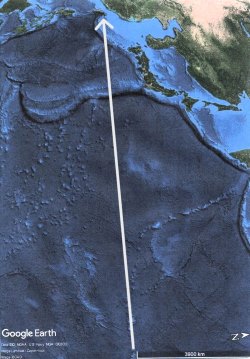
Academia’s case is against the amply-evidenced colossal fragmenting comet impact making our planet the unusually watery one that it is.
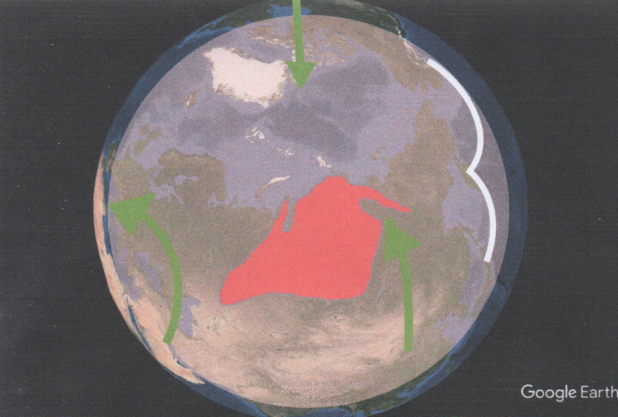
KEY (requiring readers to leave Plate Tectonic Theory’s assumption-packed paradigm box and, instead, apply the factual Natural Law by which the Earth has constantly been compelled to improve concentric density layering around its centre. This compulsion (= Law of Nature) is discussed in the letters to the RAS etc.
Translucent Area = the approximate area within which there are numerous indications of a volatile-rich mantle penetrating impact. It inevitably left an overall kilometres-deep and largely dried-out depression over magma enriched both with comet volatiles and engulfed ocean water obviously converted into OH).
What else could conceivably have delivered Earth’s wealth of water into the mantle?
Landlocked seas with abnormal chemistry were compellingly eventually formed by aqueous solutions escaping upwards by all possible means out of the vast inevitably damaged and low-lying area left after the initial backfill of most logically disintegrated comet craters. This was followed by a geologically extremely long lifting of land and sea floors by volatiles under crust exerting outward forces.
Many more distinct kinds of mutually corroborating evidence exist within and outside the very approximately drawn translucent area. But generally –
Red Area = approximately that occupied now by the Siberian Traps, these most logically formed by volatiles forcing lavas and ejecta out of volcanoes above the deepest impact zone. Continental crust had been drawn over and down into the immense overall impacted region extending over much of the northern hemisphere. The backfill was inevitably rich in makings of volatiles, mainly water. Other volcanic centres were also logically formed under such as parts of China, the Deccan, and the North Atlantic, most notably under Iceland.
White arcs mark existing water-filled trenches into which denser ocean crust slabs have long been drawn down (= subducted).
Green Arrows = very approximate directions of movement of continents transported by magma dawn down into the overall deeply damaged area.
And academics’ consensus is against an almost direct mantle-penetrating asteroid impact ca.65mya. This formed the Sunda/Filipino plates and a down-faulted density-reduced offshoot to the east-south-east and extending as far as New Zealand (This is not shown but clearly it diverted Australia’s movement towards a target far to the south-east of Taiwan).
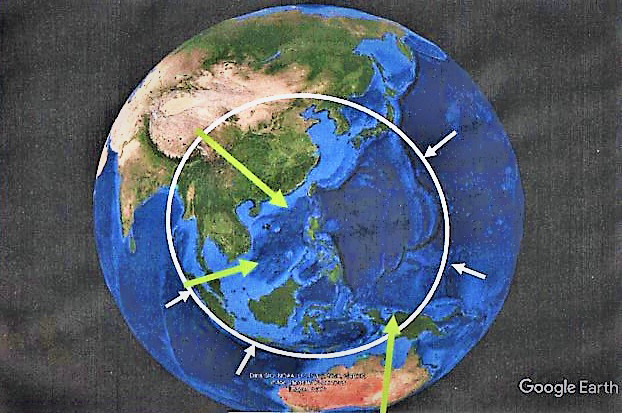
KEY. White Outline = identifiable as substantially water-filled trenches into which denser ocean crust slabs inevitably sank slowly under Natural Law into relatively low-density magma below the impact zone.
White Arrows = examples of subduction instigated by the impact. This solves the enigma of how subduction got going because nothing but contrivance would explain it otherwise. And both Laws of Physics and Nature dictate that nothing at all would cause natural flow down into a closed cell.
Green Arrows = approximate directions of movement of continental crust carried by drawn-down magma.
Other compelling Impact Evidence = all the shapes and lithological and structural characteristics of the islands within the impact zone, their sediments, metamorphism, intrusions, calderas, back-arc volcanoes etc. The last-mentioned make sense only without the contrived notion of recycling of subducted water, this idea derived from demonstrably non-representative laboratory tests. Of course, the making of H2O (OH) can be and is retained inside short-lived so effectively sealed samples in laboratories but not by any true Laws in the exceedingly slow-moving but nonetheless metamorphically differentiating mantle. That is, there would be an overwhelming compulsion for any H2O/OH to rise out of subducted slabs at very earliest opportunities, and not take part in any advanced metamorphic stage like chlorite to hydrous amphibole.
And academics’ consensus is against another well evidenced mantle-penetrating asteroid impact ca.65mya, this time inclined and from the west-north-west. It formed the Scotia Plate and deformed the southern end of South America and northern Antarctica precisely as would be expected.
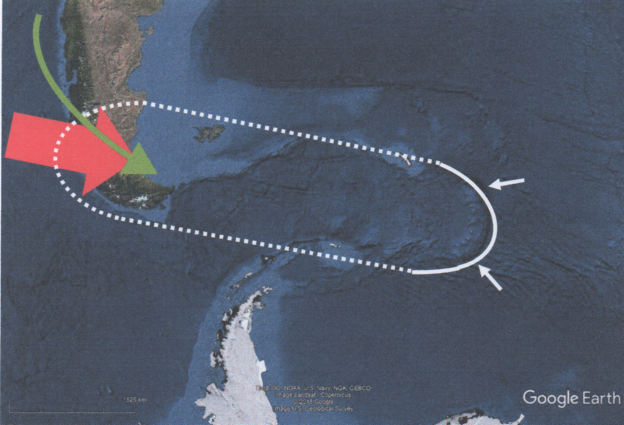
KEY. Large Red Arrow = inclined impact (schematic).
Solid White Line = actual hole filled with water (= trench) into which ocean crust would inevitably subduct under Natural Law. It would then go on sinking slowly into all relatively low-density material in the upper mantle, presumably including remaining parts of the bolide plus combined OH and maybe some continental crust forced into the mantle by the bolide.
Dotted White Line = indicative entry point of the bolide and part of the length of the inclined tunnel crater. Please note that the actual impact location could have been further to the west-north-west.
Small White Arrows = examples of directions of subduction.
Green Arrow = approximate movement of continental crust, excluding some mass movements of Antarctica, South America and ocean crust caused by the much larger impact that produced the Sunda-Filipino Plates.
Other Evidence = The faulting at the southern end of South America and the pattern of subduction of ocean crust towards this same end of South America, including a length of older plate boundary in the SE Pacific. And, again, the pattern of flow of surrounding magma into what is a compelling representation of what could be an impact.
And academics’ consensus is against yet another amply evidenced mantle-penetrating asteroid impact ca.65mya, again inclined from the west-north-west. It formed the Caribbean Plate and eventually the islands strewn above and along the margin of the tunnel crater, as makes full sense.
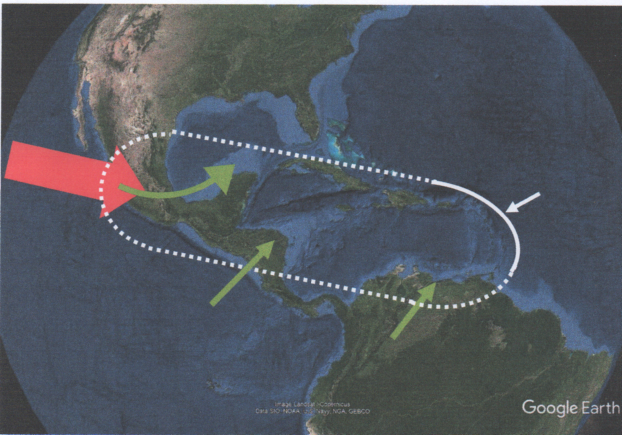
KEY. Solid White Line = actual hole filled with water (= trench) into which ocean crust would inevitably eventually subduct after being dragged by magma, and then sink naturally into low-density material in the upper mantle, presumably including remaining light fractions of the bolide plus combined OH and maybe some continental crust forced into the mantle by the bolide.
Dotted White Line = confidently inferred gouge of the bolide and the main length of the tunnel crater it formed. Of course, the actual impact location could well again have been further to the west-north-west.
Small White Arrow = example of direction of subduction.
Green Arrows = approximate movement of continental crust partly excluding mass movements of North and South America instigated by the impact that produced the Sunda-Filipino – and in the case of North America, some ongoing drawdown (not fall back) towards the comet impact zone, this now estimated to have struck something over a billion years ago.
Other Evidence = again, the pattern of flow of surrounding magma into what was compellingly a tunnel crater. The facts of what exists now could not conceivably have been produced by it being anything else. Plus, again, all the shapes and lithological make-ups of the islands within and bordering the impact zone, their metamorphism, basic intrusions and sediments as they are, melanges and generally chaotic tectonism, the distribution of cenotes, back-arc volcanoes etc. Plus, the known existence of salt in highly disturbed red beds at great depths under the Gulf of Mexico. The last-mentioned makes so much more sense without relying on the contrived notion that they sank into material denser than themselves. This was another scientifically inadmissible assumption, that a true Law was overwhelmed out of sight in the Earth but this time not even having anything to do with the (invalidated) Rayleigh Taylor Instability notion. One could go on criticising (i) the stock demand that one must find iridium and/or strained quartz to identify the site and scale of an impact and (ii) the statistically ill-based conclusion that mantle-penetrating impacts evidence long long ago.
More on the missed evidence for an impact origin of the Caribbean plate. A paper by Maria Antonieta Lorente in Geoscientist 19.9 September 2009 discussed the Pacific origin of the Caribbean Plate. It was valid but did not explain what exists within and around the Plate. The authors rightly used common sense to reject an ‘impossible (tectonic) bending’ of a ‘… linear arc … into an extreme curve’, but they clearly did not consider anything moving at impact speed.
It also made no scientific sense to postulate natural flow down into the substantially closed Caribbean cell.
The Puerto Rico trench’s extreme curve at its eastern end could not be related realistically to any (assumed) notion of cooling so close to a mid-ocean ridge.
Nor could assuming that cooling of ocean crust rationally cause it to fracture there. And if the entire Caribbean plate had overthrust rocks to its east there would surely have been some folding in front of the thrust.
Mexican volcanism is most logically associated with the visibly well-evidenced anticlockwise rotation of ocean crust towards the Caribbean. It compellingly means that underlying magma was drawn down into a still incompletely back-filled tunnel crater – plus that volatile enriched magma is still moving continental crust towards Siberia.
The extraordinary geology of the (relatively low-density) continental crust under the Gulf of Mexico is most logically due to its collapse into a space produced suddenly and explosively by the deep impact. From there, the logically progressively fracturing and flattening asteroid bolide went on to form a tunnel crater reaching as far as the Caribbean Island Arc (= the extreme curve mentioned above). Other re-stabilising processes, such as salt diapir formation and the rise of oil, were also inevitably prompted by the impact.
The magmatic flow indicated by the rotational accretion features to the west also makes full sense of impact-instigated subduction under Mexico and central America as well as under the extreme curve at the Plate’s eastern end.
The extraordinary Sigsbee escarpment is consistent with a massive sudden and violent removal of rock from well below those now outcropping in the scarp, so including older salt-bearing Mesozoic sediments. Hence, it is compelling that the aftermath of the (hitherto grossly underestimated) Chicxulub impact is still causing unrecognised instability below the Gulf of Mexico’s oil-bearing sediments, and even much more danger for reasons derived from the objectively incontestable fact of an impact.
The pattern of cenotes associated with the (misunderstood) Chicxulub impact marks an easterly continuation of effects of solution of limestones by fluids rising out of the tunnel crater. They are consistent with the asteroid being more like 150km in diameter and so careering through continental crust like a bullet. Any other proposal should therefore have been discounted.
The imbrication/melanges/olistoliths and chaotic mixtures of metamorphosed sediments and igneous rocks in islands bordering the northern and southern walls of the logically widened tunnel crater now have clear impact and ensuing tectonic significance.
Of particular interest, the Scotland District of Barbados explains the apparent absence of subduction beyond part of the eastern limit of the tunnel crater. The entire Barbados Ridge was clearly due to soft sediments being banked up there by westward subduction, and then to them slumping. The lightness of the sediments meant that they would be lifted quickly in geological terms with relatively little seismicity.
Formation of the Bahamas’ dolomite was a logical result of magnesia-rich fluids escaping upwards into what became a relatively shallow water environment after water first seeped further and further down into the impact gouge and then forced itself upwards after being heated, converted to OH and dissolving salts. It is also entirely logical that the clearly visible feature south of the Mitchell Escarpment marks a now drowned river course flowing westwards into a likely very warm Gulf of Mexico.
This raises another point of fundamental importance outside the Caribbean Plate. Meanders across the Demerara plain could only have been formed practicably as sub-aerial rivers coursing across a dry to shallow-water-covered plain draining into the Puerto Rico trench and thence down into the tunnel crater. This debunks the hypothesis that countless such features were scoured out by deep-water turbidity currents. That notion across such a wide plain was surely never replicated in any practical test.
In particular, a drainage profile through the Vidal Sea Channel and into the Puerto Rico trench (see the Figure below) confirms that early mainly shallow Atlantic waters were circulating long after the impact. To even contemplate that the Channel was formed by, and/or served as access for water heavily laden with churning sediment was, frankly, contrivance beyond the extreme. And yet this postulate, of turbidity-current delivery of sediments from the south to the Barracuda Plain, combined with backward erosion of the Channel, passed peer review. This was while no case for the Caribbean and other plates’ impact origins was ever discussed in any publication despite no other origin being mentioned beyond it being an enigma.
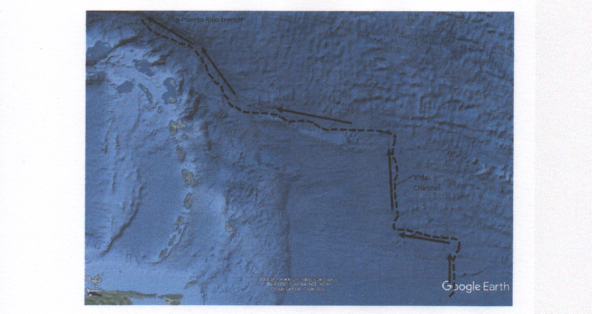
A compelling reason is therefore provided by several unambiguous facts and independent lines of evidence for the K-Pg mass extinction and the Palaeocene-Eocene Thermal Maximum.
There is no doubt that re-inspection of existing data will confirm and add to this list but, due to the need for urgency in attending to safety matters, suffice it to say here that there could be no scientific argument against deep impacts taking a leading place in a much-revised academic written record.
In conclusion, any continued refusal by anyone in academia to discuss impact plate origins would be unthinkable. And Professor Ludden and Dr Summerhayes in particular must therefore be made to answer a key question, publicly, with no bias, and with complete honesty. Why exactly did mantle penetrating impacts definitely not trigger dangerous global changes in Earth’s tectonism and volcanism, and a further disintegration of Pangea, as asserted long ago was amply-evidenced?
Correction of the Hydrothermal Circulation Assumption. In the illustration below, upward flow of superheated aqueous fluid is shown as issuing at 350 ̊ C out of a black smoker. It shows irrationally that seawater permeated down into the ocean floor, curved round and then rose without any H₂O or makings of it doing the same up out of the underlying magma.
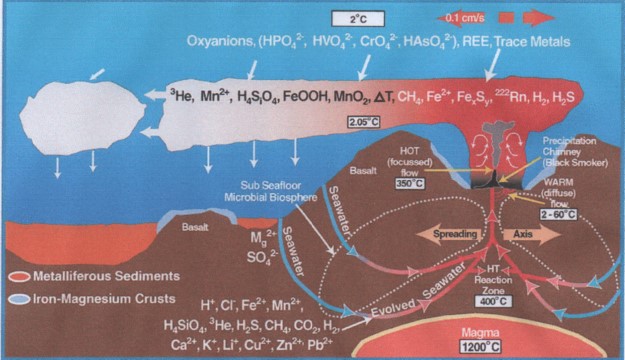
No geophysicist would postulate that water permeates down into saturated sediments below a water table in continental crust. They know it raises the water table and runs down its sloping surface to feed eventually into open water, the table being the water’s surface.
The water table above the black smoker in the illustration is therefore at sea level, perhaps kilometres above the saturated ocean floor. So, the illustration could not conceivably be right.
Inevitably pressurised fluid in the vent up which permeated seawater is imagined to return to the ocean would have had to be connected to the magma for accretion to take place. So, none of the illustrated circulation makes sense.
Therefore the black smoker water must be reaching the surface for the first time since the makings of it were combined into the mantle as a consequence of a deep impact.
An inescapable consequence of the inexcusable technical mistake in Geophysics and Geochemistry is that the hydrosphere’s development has always been misinterpreted. And when questioned the entire academic Institution will have to acknowledge making this and many other grave errors in interpretations based on unnecessary and impracticable assumptions.
Correction of Assumptions about Thermal Subsidence and Thermally Powered Upwelling en Masse. Both these assume that heat has generated and driven all motion in the Earth. This grossly overestimated what heat could do. One correction above proved this for the upward stage but observation-based true Laws went further to disprove all notions of mass upwellings of the mantle’s magmatic mixtures.
Because of undeserved faith in peer review, lifting of dense cohesive bodies of ultrabasic magma by more powerful lighter fluids derived from bolides escaped detection by both geophysicists and geochemists. Instead, they resorted to unnecessary inadmissible assumptions and contrivances that forced facts to fit into postulates that could never explain what fell into place effortlessly when guided by factual Laws.
The contrivances included those of ocean crust sliding over a static or nearly static asthenosphere, it assumedly cooling critically so that it fractured itself, subducted into arcuate-outlined closed cells, densified in a purely assumed manner, and supposedly stayed cool as it sank through increasingly dense mantle to an imagined temporary resting place – all for no stated reason excluding any role for what made the Earth – impacts.
Correction of Assumptions about Sedimentary Basins. Plate Tectonics assumes that rifting of lithosphere was due to magma spreading in two directions underneath it. But what set so-called sedimentary basins apart from new ocean creation elsewhere was that the already unnecessarily assumed two-way divergence stopped so that the supposedly separating magma cooled and so densified. The assumed-to-be cooled magma then assumedly sank, with the whole process excluding any significant chemical or density differentiation. Despite the magma’s coefficient of contraction having to be hopelessly unrealistically high the magma was thus assumed to reverse its upward journey by assumed thermal subsidence.
The imagined thermal contraction and subsidence supposedly often involved the formation of grabens. But somehow horsts could also be thought of as inferred objectively wherever marine sediments rose above present sea level.
Assumption in standing Earth Science is being repeatedly exposed as not standing up to basic scrutiny. In the case of sedimentary basins, at some depth in the Earth their formation required lighter material to sink impossibly into denser material. And in other respects too, the sequence of events is hereby charged with being contradictory when one takes account of the several different plate moving mechanisms all claiming to be the one moving the magma.
That is, the purely assumed thermal subsidence process is half of another wrong assumption termed yo-yo tectonics, not discussed here in detail to save space.
Under fact-based Laws, it was inevitable for red beds and salt layers under the Caribbean plate to end up occupying volumes of the Earth at extraordinarily low absolute elevations under the Gulf of Mexico. As previously stated, this could only have resulted realistically from them both collapsing into what was left low in density by a huge mantle penetrating impact after an initial ‘emergency’ repair of its tunnel crater.
And other sedimentary continental crust in the northern hemisphere was deposited both laterally far from where it occurs today when, compellingly, sea levels dropped to far below those of today due to the disintegrating comet impact.
The only factual-Law-based explanation accommodating all the facts coherently, and so the one that must be favoured over any assumption and under uncompromising rules of the scientific method, is that under for instance the North Sea there are only horsts with different uplifts out of an expanding sphere. Briefly, actualities had nothing to do with impossible-to-reproduce two-way spreading but everything to do with drawdown of magma out of which makings of volatiles, especially water, were compelled to rise in search of stability.
This compulsion is agreed globally to be what drives the rise of salt and oil out of their source materials, so why not also makings of volatiles? This was the rationale that constituted the core of a new Geology answering all questions posed by the Earth.
So, we are sure that on being asked a few key questions in the public domain leading advisers to governments worldwide will at last have to admit to making fundamental errors in their science as it is still being taught.
Purposely repeated corrections go on to select from an old draft document in the Notes for Academia. The Notes were drafted to disprove mutually irreconcilable plate postulates at different times in the past.
The Origin of the Caribbean Plate
This is a repeat one of the Notes for Academia to remind the addressees of a letter to be published soon under Correspondence of their bounden duty to reply explaining why they did not even question Newton’s impossible assumption made four centuries ago. Nobody could conceivably positively want them not to comply with the most basic rules of their profession.
A paper by Keith James and Maria Antonieta Lorente, representing the Geological Society of London (GSL) in Geoscientist, September 2009, discussed the Pacific origin of this plate. Although convincing, the paper failed to present any other explanation for what exists within and around it.
The GSL had accepted the authors’ principal line of reasoning. It was common sense, rejecting an ‘impossible (tectonic) bending’ of an original ‘…. linear arc …. into an extreme curve’.
Fact-based Geology supports this use of common sense to conclusively refute an assumptive postulate and so can argue similarly that the GSL must accept that its inability to provide a replacement explanation was attributable to Plate Tectonics’ impossible mechanism.
No-one has or ever could produce a definitive scientific argument for the Caribbean plate being of tectonic origin. Nor could it for the Scotia plate, nor the Sunda/Filipino plate and nor for what is now deeply submerged under most of the northern hemisphere. These facts are again of immense significance and should be at the forefront of all this site’s informed readers’ minds.
These statements are facts, not theories, because not only did Nature require rock not to do what any of its Laws would allow in the visible world, but the Caribbean plate in particular exhibits rock structures and movements in such variety and yet coherency that there can be no alternative to it being the still lethally dangerous product of a mantle-penetrating impact.
A full discussion of what the Geoscientist paper correctly refuted will lead to a much-needed revolution in Geology. And the full set of 20 Notes will, we trust, be accepted as a perfectly coherent account of the history of the Earth provided by all tectonics and volcanism being instigated by deep impacts.
Because learned Institutions are fully capable of recognising that this website contains more than ample proof of tragic errors, it suffices here to simply list the following as an incontestable summary of all that exists in and around the Caribbean being the outcome of an oblique deep impact from the west. But the paper did not and could not explain how the region’s features formed in any other way.
-
For instance, any other formation would require convective downflow of magma into a closed cell against every rule of Physics and common sense.
-
The Puerto Rico trench and its extreme curve at its eastern end simply cannot be related at all realistically to any assumed two-way spreading ridge.
-
Mexican volcanism is most logically attributed to visibly well-evidenced anticlockwise rotation of crust carried by magma as it was drawn down into the tunnel crater and, when other factual evidence is taken into account, tension separating this drawdown from another older but still continuing north-westerly one.
-
The extraordinary geology of the relatively low density continental crust under the Gulf of Mexico is compellingly due to its collapse into a space produced explosively by the impact. From there the logically disintegrating asteroid bolide went on to form a tunnel crater extending as far as the Caribbean island arc (the extreme curve mentioned in the above paper). Other re-stabilising processes under Natural Law were also triggered (e.g, salt diapir formation).
-
Magmatic flow indicated by the rotational accretion features preserved in ocean crust west of Mexico also makes full sense of impact-instigated subduction under that country and central America when combined with the above-mentioned older north-westward flow and the extreme curve at the plate’s eastern end,
-
The extraordinary Sigsbee Escarpment is consistent with a massive sudden and violent removal of rock from well below that now exposed in the scarp, so including older salt bearing Mesozoic formations. So it is compelling that the tremendous explosion generated by the (hitherto grossly underestimated) Chicxulub impact created the proven to be extremely dangerous instability below the Gulf’s oil-bearing formations.
-
The pattern of cenotes above the mapped Chicxulub impact site, and notably the easterly continuation of effects of solution of limestones by rising fluids, are entirely consistent with the bolide being more like 150km in diameter and careering through continental crust like a bullet.
-
The imbrication/melanges/olistoliths and chaotic mixtures of metamorphosed sediments and igneous rocks in islands bordering the northern and southern sides of a logically widened tunnel crater now have clear significance.
-
Of particular interest the Scotland District of Barbados most logically explains the only apparent absence of subduction beyond the eastern limit of the crater. It was clearly due to soft young sediments being banked up there by westward subduction and then slumping. The soft nature of sediments on top of ocean crust being carried by magma were logically squeezed and lifted quickly in geological terms with relatively little seismicity.
-
Formation of the Bahamas’ Palaeogene dolomite was the logical result of magnesia-rich fluids escaping upwards into what became a longstanding and fast-moving shallow water environment as water first seeped further and further down into open spaces before bursting upwards again after being heated. It is also entirely logical that the clearly visible feature south of the Mitchell Escarpment was a now drowned perhaps later river course, flowing westwards into a likely very warm Gulf of Mexico.
-
This raises another point of fundamental importance outside the Caribbean plate. Meanders across the Demerara plain could only have been formed practicably as sub-aerial rivers coursing across a substantially dry plain due to drainage into the tunnel crater. This debunks the hypothesis that became a popular theory, that such features were scoured out by turbidity currents, phenomena here and elsewhere that all defy reason and are incapable of replication in any practical test.
-
That is, a drainage profile through the Vidal channel and into the Puerto Rico trench further confirms the logic of early shallow Atlantic waters being circulated rapidly due to elevated temperatures long following the impact.
-
And, very briefly, a compelling reason is provided by several unambiguous facts and independent lines of evidence for the K-Pg mass extinction and the Palaeocene-Eocene Thermal Maximum.
There is no doubt that re-inspection of existing data will confirm and add to this list but, due to the need for urgency in attending to safety considerations, suffice it to say again that there could be no scientific argument against the impact origin of the Caribbean plate now taking a leading place in the academic written record. And one would add risk of exceptionally high fluid (technically pore) pressures to the GSL paper’s content. I quote, ‘1) many projects are premised (and funded) upon it (a Pacific origin for the Caribbean plate), and 2) all data are interpreted in an oceanic context. There is strong resistance to alternative models that could provide important possibilities for new resource exploration and improved seismic risk control.’
So in summary any continued rejection of an impact origin for the Caribbean and other plates by leading Institutions, with no scientific substantiation, would clearly be unprecedentedly unprofessional and indefensible.
Indefensible Omissions in Risk and Benefit Assessments in Physical Science.
This Note focused again on the Caribbean Plate, especially where deep drilling is taking place in the Gulf of Mexico where mistakes are most indefensible. This is because peer-reviewed papers have not considered alternatives to standing assumptions breaking the rules of the scientific method and codes of practice of all leading physical scientists. They all demanded assessment of every alternative, not just the one that grabbed their attention in peer-reviewed papers.
Before introducing the alternative that was clearly never considered, the following question must be answered comprehensively and with utter honesty by all those named on the Cc list in letters to be published soon under Correspondence.
WHAT DID YOU DO TO TRY TO PROVE ANY STANDING THEORY WRONG?
If more lives are not to be lost in vain, and if more catastrophes are to be avoided potentially far worse than the one that took 11 human lives, wreaked untold damage on the natural environment, and all but destroyed the Deepwater Horizon drilling platform in 2010 are to be investigated as they should be, it is absolutely imperative for the public to be made aware that injustices have been committed regarding tragic consequences of academic failings when researching the basic reasons for earthquakes, volcanic eruptions and other major natural geohazards that are threatening lives and safety in projects involving drilling deep boreholes in parts of the world destabilised by mantle penetrating impacts.